

Refrigeration · HACCP · New category
Remote temperature and humidity monitoring: how to replace paper logs with automatic HACCP recording
Two entries a day in a paper log show the temperature at two moments. They don't show what happened at night when the freezer compressor stopped, or on Saturday when someone left the cold room door open. An automatic system measures every few minutes, stores the records itself and alerts you immediately. In this article: what the regulations require, how the system works, how to install it in your existing fridges and freezers, and which reports to prepare for a food safety inspection.
2 → 96+
readings per day: paper log versus automatic recording at 15-minute intervals
24/7
alarms by SMS, email or app — including nights, weekends and holidays
~120 h
of staff time saved per year in a kitchen with 10 refrigeration units
In this article
- Why a paper log is no longer enough
- What the regulations require
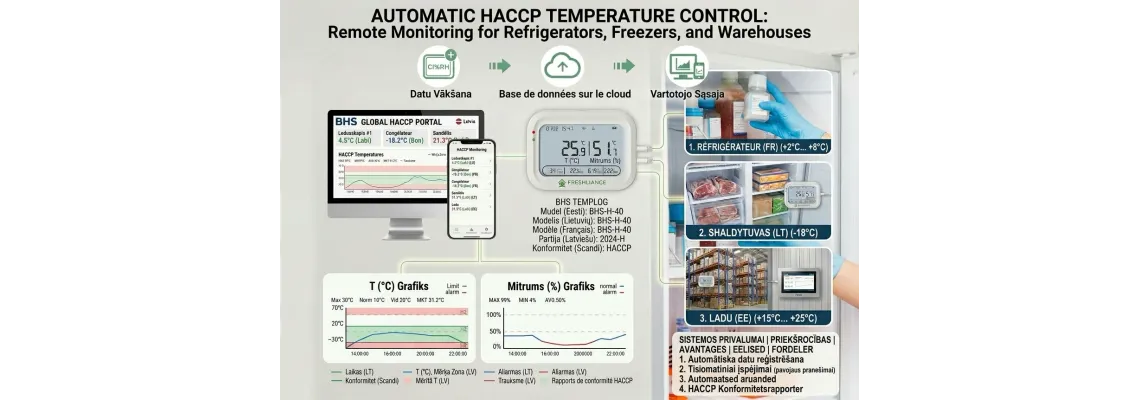
- How automatic monitoring works
- Sensors: which one for what
- Communication: Wi-Fi, LoRaWAN, GSM
- Alarms that work instead of annoy
- How to install the system in existing equipment
- Reports for the food safety inspection
- Benefits and payback
- Where to start: kits by type of business
- Frequently asked questions
01Why a paper log is no longer enough
In our article Food storage rules in the refrigerator, one of the most read on our blog, we stressed that food storage in a professional kitchen is a HACCP control point. Temperature must be checked at least twice a day and written in a log. The requirement is right, but a paper log has four built-in weaknesses.
It only sees two moments
It gives no warning
It is easy to fill in “later”
It gets lost and wet
✎ A typical case from practice
02What the regulations require
No regulation demands an automatic system as such. But all of them require reliable temperature monitoring and verifiable records — and an automatic system delivers both better than paper.
| Regulation | What it sets out | What it means in practice |
|---|---|---|
| Regulation (EC) No 852/2004 on food hygiene | Food businesses must implement a self-control system based on HACCP principles, with monitoring of critical points and documentation. | Refrigeration temperature is a critical control point. It must be monitored and recorded. |
| National hygiene guidelines for catering (Latvia) | Fridges and cold rooms — no higher than +5 °C; freezers — no higher than −18 °C. Thermometers verified at least every 4 years. Externally readable recording devices are recommended. | The limits to set alarms on, and the requirement for verified instruments. |
| Rules on quick-frozen foods (Directive 89/108/EEC, national law) | Quick-frozen food must be kept at −18 °C or colder throughout the chain, with minimal fluctuations. | Freezers and freezer rooms need continuous control, not just a morning check. |
| Regulation (EC) No 37/2005 | Storage and transport of quick-frozen food use instruments conforming to EN 12830. Records must be dated and kept for at least one year. | For large freezer rooms and warehouses, the system must meet EN 12830 and keep at least a year of data. |
🔍 What the inspector really wants to see
03How automatic monitoring works
The system has four parts. They may come from different manufacturers, but the principle is the same.
STEP 1
Sensor
Measures temperature in the fridge, freezer or cold room — and, if needed, humidity and door status.
STEP 2
Transmitter
Sends a reading every 1–15 minutes, wirelessly or by cable. Sensor and transmitter are often in one housing.
STEP 3
Gateway
Receives signals from all transmitters and sends the data to the internet. Some systems don't need one.
STEP 4
Cloud
Stores the data, compares it against limits, sends alarms and generates reports.
STEP 5
You
See all units on your phone or computer, receive alarms and download the report for an inspection.
An important detail: a good transmitter also stores readings in its own memory. If the internet or power goes down, no data is lost. When the connection returns, the transmitter sends it later and the data series has no “holes”.
04Sensors: which one for what
| Sensor type | What it measures | Where it's used | What to watch |
|---|---|---|---|
| Air temperature sensor | Air temperature in the unit | Fridges, refrigerated counters, display cases | Reacts quickly to door openings, so alarms need a delay |
| Probe in buffer liquid (glycol bottle) | A temperature close to product temperature | Fridges and cold rooms with frequent door openings | Doesn't trigger false alarms, as a brief wave of warm air doesn't affect it |
| External probe on a cable | Temperature down to −40 °C and below | Freezers, blast freezers, freezer rooms | The transmitter stays outside and the cable passes through the gasket — the battery doesn't freeze and the signal isn't blocked |
| Temperature and humidity sensor | Temperature and relative humidity (%) | Dry stores, dry-ageing cabinets, vegetable rooms, proofing | Humidity sensors drift over time and need periodic checks |
| Door contact | Whether the door is open and for how long | Cold rooms, freezer rooms | Helps tell a breakdown from a door left open |
Professional sensors typically have an accuracy of about ±0.3–0.5 °C. Check whether the manufacturer provides a calibration certificate and whether sensors can be recalibrated or replaced periodically.
✔ Why a buffer probe changes everything
05Communication: Wi-Fi, LoRaWAN, GSM
The sensor has to get its data to the internet. The choice depends on the layout, internet availability and how many units you need to monitor.
| Technology | Range | Battery life | Advantages | Drawbacks |
|---|---|---|---|---|
| Wi-Fi | Within one room or floor | Months to 1–2 years | No gateway needed, easy installation | Depends on Wi-Fi stability; metal housings weaken the signal |
| LoRaWAN / similar radio protocols | Hundreds of metres, through several walls | Up to 5–10 years | Very low consumption, reaches basements and cold rooms | Needs a gateway |
| GSM / LTE-M / NB-IoT | Anywhere with mobile coverage | 1–5 years | Independent of the site's internet; suits remote sites and transport | Needs a SIM or data plan; weaker signal in basements |
| Wired (Modbus, Ethernet) | Limited by cable length | Mains powered | The most stable connection; suits production | More expensive installation, less flexible |
For most restaurants and canteens, the best compromise is wireless sensors with a gateway. One gateway covers the whole kitchen, including the basement store and cold rooms.
06Alarms that work instead of annoy
The alarm is the system's main value — and the most common place for mistakes. Too many alarms and they get ignored; too few and they don't help. A correctly set alarm has four parameters.
| Parameter | Fridge | Freezer | Why |
|---|---|---|---|
| Upper limit | +5 °C (meat, fish +3 °C) | −15 °C (warning), −12 °C (critical) | A warning before the legal limit gives time to react |
| Lower limit | 0 °C | −30 °C | Frozen vegetables or dairy are also a loss |
| Delay | 20–30 min | 30–45 min (defrost cycle) | Door openings and defrosting must not trigger alarms |
| Escalation | Shift leader → after 15 min manager | Same + service | If the first recipient doesn't react, the alert goes to the next |
✎ What happens at night: the ideal scenario
It is also important to set technical alarms: low battery, sensor not sending, gateway offline. Without them, the system may go silent exactly when it's needed most.
07How to install the system in existing equipment
The good news: you don't need to replace your fridges and freezers. A monitoring system can be fitted to any working unit, regardless of brand or age. A typical restaurant with 8–12 units does it in one working day without stopping the kitchen.
- Inventory. List all refrigeration units: fridges, freezers, refrigerated counters, display cases, cold and freezer rooms, blast freezers. For each, note what is stored and the HACCP plan limit.
- Choosing the sensor type. Fridges with frequent door openings get a buffer probe; freezers and cold rooms get an external probe on a cable; stores and dry-ageing cabinets get a humidity sensor.
- The right sensor position. Place the sensor in the middle of the unit, where food is stored. Not right next to the evaporator or fan, where it's coldest, and not by the door, where it's warmest. In a cold room, the best spot is by the product, at about 1.5 m height and away from the door.
- Routing the probe cable. A thin, flat cable is passed through the door gasket without damaging it, or through an existing cable port. Then check that the door still closes tightly — a damaged gasket is a common cause of cold loss.
- Placing transmitters and the gateway. The transmitter is mounted outside the unit, as the metal housing weakens radio signals. The gateway goes in a central spot near a socket and the internet. After installation, signal strength is checked at every point.
- Setting limits and alarms. For each unit, set the upper and lower limits, delay and recipient chain following the principles in section 6.
- Testing. Simulate an alarm: open the cold room door or briefly remove the probe. Make sure SMS, email and call reach the right people and that acknowledging the alarm is recorded.
- Staff training and HACCP plan update. Staff must know what to do when an alarm comes and how to record the corrective action. In the self-control plan, replace the paper log with electronic monitoring, the sensor list and the alarm procedure.
⚠ The most common installation mistakes
YOUR HORECA installation and service
We install a monitoring system in your existing refrigeration units — from the audit to the first report
Audit
we survey the site, list your units and choose a sensor for each
Installation
we fit sensors, transmitters and the gateway and check signal and door gaskets
Setup
we configure limits, delays, the alarm chain and the report format for inspections
Training
we train your staff and help update your self-control documentation
If monitoring reveals an equipment problem, YOUR HORECA service is right there: 24/7 customer service +371 25 522 233, on-site repair and spare parts in stock at our warehouse in Riga, Vagonu iela 23. About YOUR HORECA service →
08Reports for the food safety inspection
On inspection day there's no need to hunt for folders. Just open the system and print or show a report for the required period. To be convincing, the report should contain these parts:
| Report section | Content | Why it matters |
|---|---|---|
| List of units and sensors | Each unit, its location, sensor ID and HACCP limit | Shows that monitoring covers all control points |
| Temperature charts and tables | Readings for the chosen period (day, week, month) with min., max. and average | Proves continuous monitoring, not just two entries a day |
| Alarm log | Start and end of each deviation, peak temperature, who received the alarm and when it was acknowledged | Shows problems are caught in time |
| Corrective actions | What was done — food moved, service called, stock written off — and by whom | This is what the inspector checks most closely |
| Calibration documents | Sensor calibration or verification certificates with dates | Confirms the readings are reliable |
💡 Tip: introduce a “digital sign-off”
09Benefits and payback
A monitoring system isn't just about compliance. It pays back in three ways.
Staff time
Losses prevented
Early fault diagnosis
If the chart shows a unit slowly losing capacity, replace worn parts in time: door gaskets, fans, thermostats or compressors. More on daily care in our article on freezer defrosting, cleaning and maintenance.
10Where to start: kits by type of business
| Business | Typical units | Number of sensors | Recommended setup |
|---|---|---|---|
| Café, bar | 1–2 fridges, refrigerated counter, freezer | 2–4 | Wi-Fi sensors or a small gateway, alarms to 1–2 people |
| Restaurant | Fridges, refrigerated counters, freezers, cold room | 6–12 | Wireless sensors with a gateway, buffer probes for fridges, external probes for freezers |
| Canteen, school, hospital | Cold rooms, freezers, dry store, serving line | 10–25 | Gateway + door contacts on cold rooms, humidity sensor in the store, reports by department |
| Hotel | Several kitchens, bars, minibars, stores | 15–40 | Several zones in one account, separate alarm chains per kitchen |
| Production, warehouse | Freezer and cold rooms, blast freezers | 20+ | EN 12830-compliant sensors, data archive of at least 1 year, wired or LoRaWAN network |
📖 Related articles on our blog
- Food storage rules in the refrigerator — temperature zones by shelf, FIFO and labelling
- Using professional freezers: how to choose and maintain — operation and maintenance
- Freezer defrosting, cleaning and maintenance — daily care and gaskets
Refrigeration equipment to fit with monitoring: refrigeration equipment, cold rooms, blast freezers and dry-ageing cabinets.
11Frequently asked questions
Can we drop the paper log completely after installing the system?
Yes, provided electronic monitoring is described in your self-control (HACCP) plan and the records are available during an inspection. The plan should state which units the system monitors, the limits, who receives alarms and how corrective actions are recorded. It's wise to keep a backup procedure with a hand thermometer in case the system is unavailable.
Can the system be installed in old fridges and other brands?
Yes. The sensors aren't connected to the unit's electronics; they simply measure the temperature inside. So any fridge, freezer, display case or cold room will do, regardless of brand or age.
What happens if the internet or power goes down?
Quality transmitters run on batteries and store readings in their memory. When the connection returns, the data is sent and the archive has no gaps. The system should send a technical alarm about the lost connection so you know monitoring is temporarily down.
How often do batteries need replacing?
It depends on the technology and the measurement interval. Wi-Fi sensors typically last months to two years; LoRaWAN-type sensors up to 5–10 years. The system warns of low battery in good time.
How often should sensors be calibrated?
Hygiene guidelines require thermometers to be verified at least once every four years. In practice many businesses check sensors once a year against a verified reference thermometer, as it's simple and increases confidence in the data.
Does a restaurant need humidity monitoring?
For fridges and freezers, temperature is usually enough. Humidity matters in the dry store (flour, grains, spices), dry-ageing cabinets, vegetable rooms and proofing equipment, where the wrong humidity quickly spoils the product.
Can YOUR HORECA install the system and help with HACCP documentation?
Yes. We survey the site, install and configure the system, train your staff and help prepare the section of your self-control plan on electronic temperature monitoring. Call +371 25 522 233.
Ready to give up the paper log?
Tell us how many and which refrigeration units you have — we'll prepare an offer with sensors, installation and setup so that at your next inspection the report is ready in one click.
This article is for information only and does not replace the text of regulations or your company's self-control plan. Specific limits and monitoring procedures are set by your HACCP plan and the applicable regulations.