

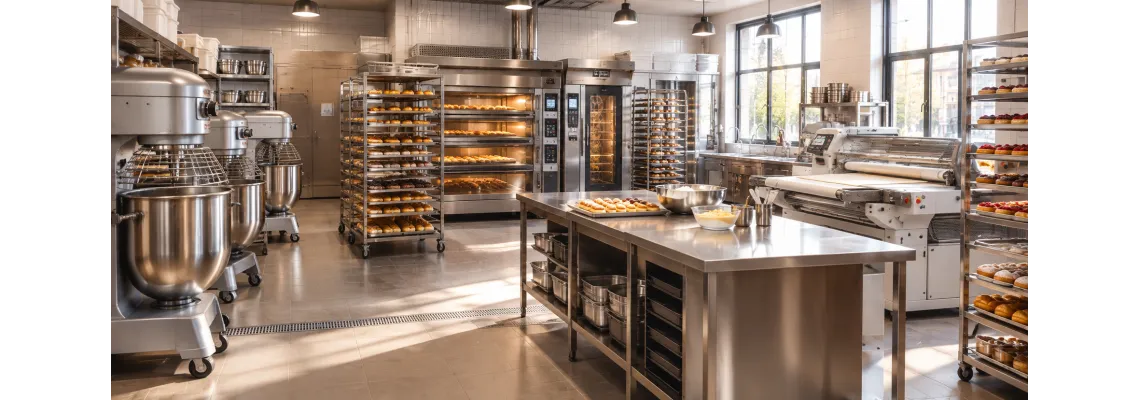
Your pastry shop: from a small patisserie to a production bakery
Planetary mixers, dough machines, proofing cabinets and pastry ovens — from a compact four-tray oven to a 16-tray line with trolleys. How to choose equipment at each stage of growth, how to maintain it and how to make sure production never stops for want of a spare part.
4–18 trays in one pastry oven | 5–80 L planetary mixer bowl capacity | 600×400 one tray standard across the whole line |
from €1,049 8-tray proofing cabinet, excl. VAT | 12 months warranty on professional equipment | 24/7 customer service |
01Three stages of growth — and why you should plan equipment for the next one
Most pastry businesses start small: a café that bakes its own cakes, or a home baker moving into their own premises. A year or two later there are more orders, shops and cafés to supply, and the kitchen becomes a bottleneck. That is exactly when you see whether the first equipment was chosen with growth in mind.
| Small patisserie | Pastry shop with store | Production bakery | |
|---|---|---|---|
| What it is | A café with its own baking, a home baker in own premises | A pastry shop with display counter and orders, small wholesale volume | Regular deliveries to shops, cafés and events |
| Daily output | A few cakes, 1–3 baking cycles | Several cycles, a permanent range | Shift work, several ovens in parallel |
| Oven | Compact, 3–4 trays | 4–6 trays 600×400 | 10–16+ trays, trolleys |
| Mixer | Planetary 5–10 L | Planetary 20 L + spiral | Planetary 40–80 L with bowl lift |
| Proofing | Compact cabinet under the oven | Digital cabinet with humidity control | Several cabinets or a retarder-proofer room |
| Cooling | Fridge + refrigerated counter | + blast chiller | + cold room |
In pastry and bakery the standard is the 600×400 mm tray. If the oven, proofing cabinet, blast chiller, tray trolleys and even the display are designed for one size, a tray travels from the bench to the display through the whole line without re-panning. Every transfer costs time, damaged product and one more tray to wash. Compact ovens often use smaller trays — fine for a start, but when planning growth choose 600×400 at the second stage.
02Production flow: how a product moves through the bakery
An equipment list makes sense when built along the product's path. Each step has its own machine, and each machine is a potential bottleneck.
01 Mixing Planetary mixer or spiral mixer | 02 Shaping Sheeting, dividing, rounding |
03 Proofing Cabinet with temperature and humidity control | 04 Baking Pastry oven with fan and humidifier |
05 Cooling Blast chiller, refrigerators | 06 Selling Pastry display or packing |
If one stage has half the capacity of the others, the whole line runs at its pace. A classic example: a new, large oven and an old 10-litre mixer — the oven waits while the next batch is mixed.
03Planetary mixers — the heart of the pastry kitchen
In a planetary mixer the tool spins on its own axis while orbiting the bowl, so it reaches the whole volume. It is the most versatile machine in pastry: whipped cream, egg whites, sponge batter, creams, shortcrust, icings. It usually comes with three tools — a whisk for whipping, a beater for batters and creams and a hook for dough.
| Bowl | Suitable for | Price excl. VAT |
|---|---|---|
| 5 L | Small patisserie, creams and icings in small batches, extra mixer | from €443 |
| 10 L | Café with own baking, 1–2 cakes per batch | €857 |
| 20 L | Pastry shop with store — sponges, creams, shortcrust for the daily volume | €877 |
| 40 L | Production bakery, motorised bowl lift, electronic speed control | €5,429 |
| 60 L | Large production, any dough | €5,879 |
| 80 L | Industrial production, stepless variator, motorised lift | €8,959 |
Prices excl. VAT from the catalogue in September 2026. All models in the food preparation machines category.
How to choose the bowl size
- Size for the largest batch, not the average. A bowl is used effectively up to about 2/3 of its volume; for whipping even less, as the mass expands several times.
- Two mixers beat one big one. While dough is mixing in the large one, the small one can whip cream or make a cream — cheaper than one huge mixer standing half-empty.
- From 40 litres a bowl lift is a must. A full 40-litre bowl is too heavy to lift by hand regularly.
- For heavy yeast dough in large volumes take a spiral mixer. A planetary can do it, but prolonged heavy kneading loads the gearbox and shortens its life.
04Dough machines: kneading, sheeting, dividing
Once buns, pastries, croissants and puff pastry appear on the menu, a mixer alone is no longer enough. The next step is machines that knead, sheet and divide dough into equal pieces.
| Machine | What it does | Price excl. VAT |
|---|---|---|
| Spiral mixer | Heavy yeast doughs — bread, buns, pies. The spiral kneads while the bowl turns, so the dough doesn't overheat | €674 – €2,315 |
| Countertop sheeter | Puff and shortcrust pastry, pizza and tart bases of even thickness | €849 – €949 |
| Floor dough sheeter | Croissants and puff pastry in production volume; wide belt, reverse | €3,249 – €7,759 |
| Dough rounder | Even, smooth balls for buns and rolls | €2,499 |
| Dough divider | Divides a dough block into equal-weight portions — manual, semi-automatic, automatic | €5,719 – €8,249 |
| Production sheeter, baguette moulder | Loaves, baguettes, long rolls in the bakery | €4,759 – €7,949 |
A baker with scales divides dough quickly, but not evenly — and uneven buns bake unevenly. A divider pays off when you divide several dozen kilograms of dough a day: it saves staff hours and reduces waste, because every piece weighs the same and bakes in the same time.
05Proofing cabinets: controlled warmth and humidity
Yeast dough rises in any warm place, but evenly only in a controlled environment. A proofing cabinet keeps temperature and humidity stable, so the dough surface doesn't dry out, croissants keep their layers, and each batch proofs as long as the last. That means a predictable schedule: you know when the next tray will be ready for the oven.
| Type | Key features | Price excl. VAT |
|---|---|---|
| Compact, 8 trays 480×340 mm | Analogue control; often placed under a compact oven on a shared stand | €1,049 |
| 8 trays 600×400 mm | Analogue control, standard pastry trays | €1,059 – €1,139 |
| Digital with water connection | Programmable temperature and humidity, push-button tank fill or direct water connection | €1,549 – €2,089 |
| Retarder-proofer room | For production: load dough in the evening, the room chills it, stops fermentation and restarts it automatically in the morning — ready to bake at the start of the shift | per project |
See proofing cabinets and ovens in the ovens category.
Digital cabinets with a water connection are the most convenient day to day: no need to remember to refill the tank, and humidity doesn't drop mid-shift. That is also why water quality matters for them — more on that in the maintenance section.
06Pastry ovens: from mini to large
A pastry oven differs from an ordinary convection oven in three ways: it is designed for 600×400 trays, it has even airflow on every level, and it has the functions dough needs — fan reverse (direction change for even colour) and a humidifier (steam for croissants, bread and puff pastry).
Mini ovens — for starting out and cafés
Compact 3–4 tray ovens with manual control, a 0–60 minute timer and up to 250 °C cost from €599 to €889. A version with humidifier and grill is about €1,079. They suit bake-off, small cake batches and cafés where the oven runs a few hours a day. They can be placed on top of a proofing cabinet to form a compact “tower”.
600×400 pastry line — 4, 6 and 10 trays
| Configuration | Manual control | Touchscreen with programmes |
|---|---|---|
| 4 trays 600×400 | €2,489 | €3,499 |
| 6 trays 600×400 | €2,579 | €3,629 |
| 10 trays 600×400 | €3,399 | €4,989 |
All with fan reverse. Touchscreen versions store multi-phase recipes (temperature, time, humidity, fan speed), so every baker bakes the same way.
Manual control is robust and simple when the range is small and bakers are experienced. The touchscreen pays off when the oven runs several shifts or different people use it: the programme ensures Wednesday evening's croissant is the same as Monday morning's.
Large ovens — the production bakery
Production uses ovens with 16–18 trays and roll-in trolleys: trays are loaded into the trolley at the bench or proofing cabinet, rolled into the oven all at once and wheeled out to cooling after baking. A 16-tray 600×400 oven costs from €7,269 (manual) to €8,179 (touchscreen); an 18-tray large-format model about €16,259. Trolleys cost €509–€589 depending on oven size.
- Two 10-tray ovens let you bake in different modes at once — sponge at 170 °C and buns at 200 °C with steam. If one breaks down, the other keeps working.
- One 16-tray oven with trolleys is more efficient for large volumes of one product type and takes less space per tray.
- In practice a bakery often has both: a large oven for the core range and a smaller one for special orders.
07Complete equipment for the three stages
Below is an equipment set for each stage with indicative prices. Each row links to the relevant category.
| Line item | Small | With store | Bakery |
|---|---|---|---|
| Planetary mixer 10 L → 20 L + 5 L for creams → 40 L with bowl lift + 20 L | €857 | €1,320 | €6,306 |
| Spiral dough mixer None → 20 L / 15 kg → 45 L for heavy doughs | — | €990 | €2,315 |
| Dough sheeter By hand → countertop sheeter → production sheeter | — | €899 | €4,759 |
| Dough divider / rounder Bakery only — equal-weight portions within an hour | — | — | €5,719 |
| Proofing cabinet 8 trays analogue → digital with water connection → 2 digital | €1,049 | €1,549 | €4,178 |
| Pastry oven 4 trays with humidifier → 6 × 600×400 touchscreen → 16 trays with trolleys + 10 trays | €1,079 | €3,629 | €13,168 |
| Blast chiller None → compact 3 GN → 5–10 trays for production | — | €2,849 | €5,500 |
| Refrigerators and refrigerated counters 600 L + 2-door counter → Eco Line + GN counter → several cabinets | €2,478 | €3,028 | €5,500 |
| Cold room Bakery only — for ingredients and finished goods, per project | — | — | €9,000 |
| Stainless tables, sinks, shelves, trolleys Including 600×400 tray trolleys in the bakery | €1,200 | €3,000 | €8,000 |
| Pastry display For café and shop; usually none in a production bakery | €2,000 | €2,400 | — |
| Dish / pot washer Front-loader → longer cycle → hood-type for bowls and trays | €1,151 | €1,959 | €2,879 |
| Steam hood over ovens Compact → wall hood with fan → system with make-up air | €749 | €1,599 | €4,500 |
| Trays, moulds, silicone mats, smallwares Allow at least 3 trays per oven level | €500 | €1,500 | €3,500 |
| Equipment total (excl. VAT) | €11,063 | €24,722 | €75,324 |
| + 10% contingency (installation, connections) | €1,106 | €2,472 | €7,532 |
| Total incl. VAT 21% (Latvia) | €14,725 | €32,905 | €100,256 |
Prices excl. VAT from the catalogue in September 2026; lines consisting of several machines or made to order are indicative. Fit-out, electrical upgrade and utilities are not included. VAT rates: Latvia and Lithuania 21%, Estonia 24%, France 20%.
08Premises, power and water — what to check before buying
- Electrical capacity. The pastry oven, proofing cabinet and blast chiller are the biggest consumers. Add up the ratings and compare with your connection — a production bakery often needs an upgrade.
- Water connection and filter. An oven with humidifier and a digital proofing cabinet need a water supply. Hard water quickly scales the steam system, so a water filter is essential, not an extra.
- Extraction. Ovens give off heat and steam; they need a steam hood, and with several ovens — make-up air too.
- Door width and trolleys. The large oven and 16-tray trolleys must get into the room and roll to the oven. Check doors, thresholds and turns at planning stage.
- Space for servicing. The technician needs access behind the oven and mixers — a machine built into a niche without clearance has to be pulled out for repair.
09Maintenance: a schedule that extends equipment life
Pastry equipment is durable, but it has common enemies — flour, sugar, fat and limescale. They settle on fans, gaskets and heating elements and gradually reduce efficiency. Regular maintenance costs little; neglected maintenance costs a lot.
| Machine | Daily | Weekly / monthly | Annually (service) |
|---|---|---|---|
| Pastry oven | Clean the chamber, wipe the door gasket and glass | Descale the humidifier; check gasket condition and fan guard | Check heating elements, fan motor, thermostat and safety thermostat; calibration |
| Proofing cabinet | Wipe condensation, air out | Clean and descale the water tank or evaporator, check drain | Check humidification system, sensors and solenoid valve |
| Planetary mixer | Wash bowl and tools, clean the body | Check tools, bowl mounting and guard switch | Check gearbox, belt, bearings and lubrication |
| Spiral mixer | Clean bowl and spiral | Check belt tension and safety lid | Check motors, belts, bearings and bowl drive |
| Dough sheeter | Clean rollers and belts of flour and dough | Check belt condition, scrapers | Calibrate roller gap, check drives |
| Blast chiller | Clean chamber and probe | Clean condenser grille of dust and flour | Check refrigerant system and fans |
- Cleaning the oven with the wrong chemicals. Aggressive products damage gaskets and enamel. Use oven cleaning products.
- A humidifier without a filter. Limescale clogs the steam system, and croissants suddenly lose their shine.
- An overloaded mixer. Too large a batch or too heavy a dough strains the gearbox — the most expensive mixer repair.
10Service and spare parts: keeping production running
In a bakery downtime is especially costly: if the oven stops the night before a big order, there is nothing to deliver in the morning. So when choosing equipment, ask not only about the price but also about what happens when it needs repair.
What we provide
- Service — warranty and post-warranty repair, installation and commissioning, staff training.
- Preventive maintenance — regular scheduled checks to replace worn parts before they fail, not after. A maintenance contract can be adapted to your shifts.
- Spare parts from our warehouse in Riga — the most requested items for pastry equipment are in stock; others are ordered from the manufacturer and delivered across the Baltics and Europe.
- Customer service 24/7 — +371 25 522 233.
- 12-month warranty on professional equipment.
Which parts wear out most often
| Machine | Most frequently replaced parts | Spare parts category |
|---|---|---|
| Oven | Door gasket, heating element, fan motor, thermostat, timer, chamber lamp | Gaskets · Heating elements · Thermostats · All spare parts |
| Proofing cabinet | Heating element, humidifier element, solenoid valve, sensor, control knobs | Heating elements · All spare parts |
| Mixers | Belts, bearings, safety switches, tools (whisk, beater, hook), bowls | All spare parts |
| Blast chiller | Fans, thermostat, probe, door gasket | Thermostats · Gaskets |
Tip: a spare oven door gasket and chamber lamp, plus a spare tool set for the mixer, cost a few dozen euros but let you keep working the same day something wears out.
11How we help build a pastry business
1 | Consultation Range, daily volume, premises and budget. From this follows which stage you are at now and what equipment the next one will need. |
2 | Design and production flow Pastry kitchen design: layout along the product path, electrical, water and extraction loads, space for trolleys and servicing. |
3 | Equipment and custom furniture Ovens, mixers, proofing cabinets and refrigeration in one delivery; stainless tables and counters made to measure — projects and custom solutions. |
4 | Installation and training Connection, first start-up, programme set-up and staff training. |
5 | Service for the whole equipment life Preventive maintenance, repair and spare parts. If a machine has to be replaced during repair, ask about equipment rental. |
12All pastry categories in one place
13Frequently asked questions
Let's plan your pastry business together
Tell us about your range, volume and premises — we will recommend equipment for this stage, prepare an estimate and a plan for how the line will grow with your business.
Customer service 24/7 · [email protected] · Vagonu iela 23, Riga, Latvia
Prices are taken from the catalogue in September 2026 and exclude VAT; they may change. Equipment set totals are indicative and do not replace an individual estimate.