

HOTEL EQUIPMENT · YOUR HORECA GUIDE
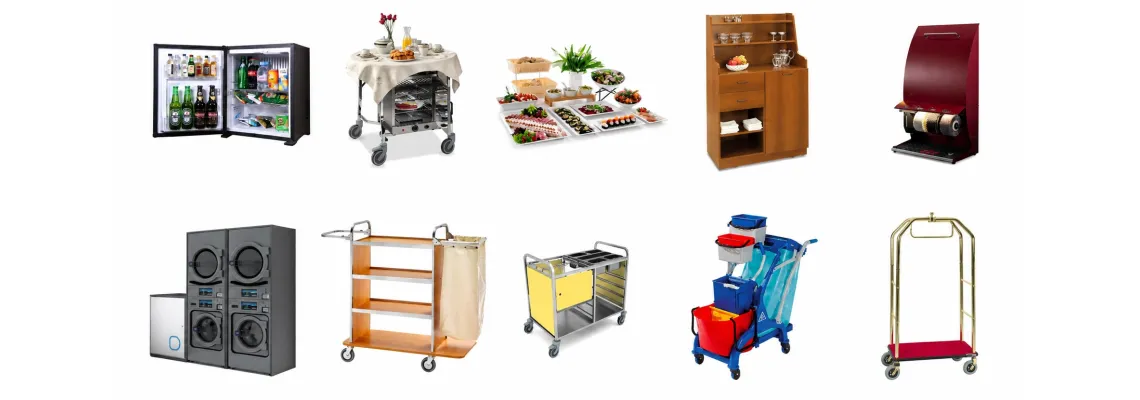
Hotel equipmentmini bar, room service trolleys, luggage and laundry carts
A guest judges a hotel by the details they only notice when those details fail: a mini bar quiet enough to sleep beside, a hot dinner that arrives hot, and a luggage cart that does not squeak across the lobby. This article explains how to choose hotel equipment zone by zone, what to check technically, and how we design and manufacture it to a bespoke project.
project design, 3D visualisation and manufacture to your own dimensions
Hotel equipment belongs to the part of the business nobody advertises, yet the guest feels it every single day. A mini bar that hums at night earns a review. Room service trolleys without heating deliver lukewarm food. Laundry carts without brakes run into doorways. That is why this inventory is chosen not from catalogue photographs but from technical parameters — and from how well it fits the actual building.
Below we go through the four groups we are asked about most — mini bars, room service trolleys, luggage carts and laundry carts — and explain what to do when standard dimensions simply will not fit your corridors, lifts or recesses.
DESIGN AND MANUFACTURE
When the standard size does not fit — we manufacture to a bespoke project
We do more than supply ready-made equipment. We design and manufacture hotel inventory and furniture to your dimensions: mini bar recesses, service trolleys with a specific shelf pitch, luggage carts matched to your lift depth, housekeeping carts sized to your linen volume. Technical solution, 3D visualisation, production in stainless steel and metal, delivery and installation — one partner for the whole cycle.
01Hotel equipment zone by zone
It is easier to plan by zone than by product category: each zone has its own load, its own noise constraints and its own hygiene requirements. Our hotel equipment range covers all six.
The guest room
Mini bar, safe, ironing equipment, shoe care. The overriding requirement is silence and a discreet appearance.
Room service
Service trolleys, heated and insulated boxes that bring food to the room at the temperature it left the kitchen.
Lobby and reception
Luggage carts, service stations and shoe care equipment — first impression and representation.
The housekeeping floor
Laundry carts, cleaning equipment and waste sorting trolleys — ergonomics and working speed.
The breakfast area
Breakfast serving dishes, bain-maries, thermoses and serving trolleys for the buffet format; see the full hotel range.
The laundry department
Laundry care equipment and carts that keep the clean and soiled linen flows apart — also in the hotel range.
Measure three things before you order: the internal dimensions of the lift, the corridor width and the narrowest doorway. Those three figures rule out more models than the budget does — and they are also the first thing we ask for when building a bespoke project.
02The mini bar: three cooling technologies
A mini bar is chosen not by capacity but by cooling principle. That principle governs the noise, the energy consumption and how deeply the unit can cool in a warm room. In a guest room, noise matters more than any other parameter.
| Criterion | Peltier (thermoelectric) | Absorption | Compressor / display type |
|---|---|---|---|
| Principle | Thermoelectric element, no moving parts | Heat exchange without a compressor | Classic compressor with an evaporator |
| Noise | Practically inaudible | Practically inaudible | Audible — not for a room beside the bed |
| Depth of cooling | Depends on room temperature | Stable, good in a warm room | The deepest, independent of the room |
| Suited to | Standard rooms, chilling drinks | Higher-category rooms, spas | Lobby, bar, display cabinet |
| What to watch | Needs airflow at the back | Must stand level and free of vibration | More heat output and more noise |
Our range holds all three: quiet mini bars for hotel rooms from 24 to 55 litres, including glass-door models for warm rooms, and larger display units for the bar area, where noise is no longer the deciding factor.
Thermoelectric and absorption mini bars work without a compressor, so at night they cannot be heard. It seems a small detail, but night-time noise is one of the most common reasons a guest writes “could not get to sleep” in a review.
03Mini bar capacity and built-in installation
Choose the capacity from the room category and from what you will realistically keep inside. In practice, an oversized unit only means higher energy consumption and a half-empty shelf.
| Room category | Recommended capacity | Type | Note |
|---|---|---|---|
| Budget room, guest house | 20–30 l | Peltier | Water and soft drinks |
| Standard room | 30–40 l | Peltier or absorption | Drinks and snacks |
| Business room | 35–50 l | Absorption | A wider offer, stable temperature |
| Suite, spa room | 50 l and above | Absorption or glass door | Wine, champagne, presentation |
| Lobby, lobby bar | 48 l and above | Glass-door display | The product is visible and it sells |
First, ventilation: a mini bar needs an air gap at the back and above, otherwise it will not cool and it wears out faster. Second, access: staff must be able to restock and clean it without dismantling the cabinet. Those two constraints are exactly why a mini bar recess is one of the most frequent bespoke-project tasks we take on.
04Room service trolleys and insulated boxes
Room service is the only form of catering where a lift and a corridor stand between the kitchen and the guest. What matters here is therefore not the trolley itself, but holding the temperature on the way.
Heated service box
Stainless steel body with insulation and even temperature regulation — for hot food on its way to the room.
Insulated box with double walls
AISI 304 stainless steel with double insulated walls. Holds temperature with no electrical connection.
Refrigerated box
A chilled box for desserts, salads and drinks — so that cold food arrives cold.
Service trolley with shelves
Stainless steel, several shelves and four castors — a full dinner in a single trip.
The practical target is simple: hot food still above +60 °C at the guest’s door, cold food below +8 °C. If more than five minutes separate the kitchen from the furthest room, a heated or insulated box is not a luxury but the only way to meet that.
Castors and brakes. In a corridor a service trolley must be quiet, and in a lift it must stay put. Rubber castors with a brake cost slightly more, but they are the difference between a trolley that does not wake a whole floor on the night shift and one guests complain about.
05Luggage carts — the lobby’s calling card
A luggage cart is one of the first objects a guest sees and touches. Both the material and how quietly it rolls across the lobby matter equally here.
| Version | Character | Suited to |
|---|---|---|
| Stainless steel | The most hygienic and hard-wearing, neutral in a modern interior | Business and city hotels |
| Brass finish | Classical elegance, a warm tone, needs regular polishing | Historic and luxury hotels |
| Chromed steel | Lighter and less costly, with an extendable frame for a garment rail | Guest houses and the mid segment |
| With a garment rail | A tubular frame for coats and suits | Conference and airport hotels |
| With rubber bumpers | Protects the cart as well as the lift and doorways | Sites with heavy traffic |
The platform typically takes 3–5 large suitcases, while total load capacity runs from 80 to 150 kg depending on the model. See the whole range in the luggage cart category.
In a standard hotel, count on one luggage cart per 30–50 rooms. Conference hotels and sites with group arrivals need more: there, a whole day’s luggage flow coincides with two hours of check-in.
06Laundry carts for housekeeping
Laundry carts are the inventory staff work with for a whole shift. What decides here is not appearance but ergonomics: how often they have to bend, how easily the cart runs along the corridor and whether it fits in the lift.
What to choose for which task
- Collapsible laundry basket — the lightest and least costly solution for a small guest house; the fabric bag is replaceable and washable.
- Wheeled basket with a plastic-coated frame — for collecting soiled linen from rooms, with castors that swivel in every direction.
- Carts with shelves — for distributing clean linen room by room; the shelves let sheets, towels and room amenities be kept separate.
- Multifunction carts — shelves plus space for cleaning supplies; one unit for the whole housekeeping shift.
- Waste sorting trolleys — a separate flow that must never be mixed with the laundry carts.
The technical parameters that govern service life
- Large-diameter rubber castors — quiet on hard floors and they do not bog down in carpet.
- A frame stable under a 50–80 kg load, without “walking” diagonally.
- A stainless steel frame takes moisture and disinfectants without corroding.
- A replaceable fabric bag — washable, rather than thrown away along with the cart.
- A brake on at least one castor — essential for working in lifts and on ramps.
This is the most common hygiene mistake on the housekeeping floor. Soiled linen is collected in one flow, clean linen distributed in another, and the carts between them are swapped or disinfected. If there is too little equipment, staff will combine the two — which is why the number of carts is calculated from the number of floors, not from the minimum budget.
07Castors, noise and floor surfaces
In a hotel, every piece of inventory moves, and almost every complaint about it comes down to the castors. These five points settle most of the questions before an order is even placed.
- Rubber versus plastic. Rubber castors are quiet and kind to the floor; plastic ones cost less, but on tiles and stone they are heard along the whole floor.
- Diameter. A larger diameter clears thresholds, lift gaps and carpet edges more easily. On thick carpet, small castors barely roll at all.
- Swivel versus fixed. Two swivel and two fixed castors give directional control in a long corridor; all four swivelling gives manoeuvrability in tight spaces.
- Brakes. Essential in lifts, on ramps and anywhere a cart is left standing unattended.
- Bumpers. A rubber bumper strip around the perimeter protects the cart as well as lift walls and doorways — the repair costs it avoids pay for it faster than the bumper itself.
08Hygiene, safety and materials
In a hotel, food safety applies well beyond the kitchen. Room service, the breakfast area and the mini bar are where inspections ask the most questions.
Hot food must stay at least at +60 °C and cold food no higher than +8 °C. If the delivery run exceeds five minutes, only a heated or insulated box will achieve that — not a covered plate.
Products kept in a mini bar need their own temperature regime, and it has to be checked periodically. Anything with a shelf life needs stock records, not just restocking.
Most of our range is stainless steel: smooth, seamless and resistant to professional chemicals. Plastic parts in contact with food comply with EU food-contact requirements.
Clean linen, soiled linen, waste and food are four separate flows. Each needs its own inventory and its own labelling — the cheapest hygiene investment a hotel can make.
A loose castor, a split bumper or a brake that no longer holds is a safety matter, not cosmetics. Regular checks and timely spare part replacement cost less than a single accident.
AISI 304 stainless steel is smooth, free of seams where bacteria could gather, chemically resistant, and it keeps its appearance after years of daily duty. In a hotel, where the inventory works every day and sits in full view of guests, it is the only material that satisfies both demands at once.
09Daily care
- Mini bar: clean the interior monthly and check the door seal; keep the air gap at the back free of dust — a blocked gap is the most common cause of poor cooling.
- Service trolleys and boxes: wash and wipe dry after every shift; on heated boxes, verify the temperature with a separate thermometer, not just the display.
- Luggage carts: lubricate the castor axles every three months and check the platform fixings; polish brass and chrome surfaces with a product intended for them.
- Laundry carts: wash the fabric bags regularly and disinfect the frame; never leave damp linen in a cart overnight.
- All inventory: check castors, brakes and bumpers once a season. A five-minute inspection prevents most repairs.
Service, spare parts and fast response
A hotel runs 24/7 and its equipment cannot wait until next week. If the mini bar in a suite stops cooling or a service trolley loses a castor, it has to be solved the same day — which is exactly what our service approach is built around.
The spare parts most often needed — compressors, thermostats, fans and door seals — are in our spare parts catalogue. More on maintenance: kitchen and bar equipment service. Equipment rental is also available for seasonal peaks or while refurbishment is under way — ask our team.
10Solutions from our range
Below are typical items of hotel equipment for different budgets. The range holds entry-level solutions for guest houses as well as representative models for the luxury segment.
Mini bar 32 L with Peltier cooling
Thermoelectric cooling without a compressor — practically inaudible in the room. An entry-level solution for a standard room.
View the category
Display refrigerator 48 L with a glass door
The glass door makes the product visible — suited to the lobby area and to suites, where the mini bar also sells.
View the category
Mini bar TM55 with an absorption system
Quiet absorption cooling and low energy consumption. The largest capacity, for business rooms and spas.
View the category
Service trolley with shelves
Stainless steel, 3 shelves, four castors. A full dinner or breakfast taken to the room in one trip.
View the category
Luggage cart with a stainless steel frame
Stainless steel frame and a folding wooden platform with a covering. A neutral, hard-wearing lobby solution.
View the category
Laundry cart with shelves
Stainless steel frame, laminated shelves and fire-resistant materials. For distributing clean linen floor by floor.
View the category
Prices are shown excluding VAT and were current at the time of publication. Please check the current price, capacities and availability on the product page or ask our team.
11Equipping a hotel from scratch — five steps
How many rooms and in which categories, how many floors, what the average occupancy is. From that follow the mini bar types and capacities, and the number of luggage and laundry carts.
Internal lift dimensions, corridor width, the narrowest doorways and the floor surface. These figures decide what can work in your building at all, and what has to be made to a bespoke project.
Whether food travels on a trolley, in boxes or on a tray, and how far the furthest room is from the kitchen. From that follows whether heating, insulation or refrigeration is required.
Where the laundry department sits, how many floors one housekeeper covers, how the clean and soiled linen flows are separated. This sets the number and type of carts.
We prepare the equipment list and, where needed, a bespoke project with 3D visualisation, agree it with you, and after approval handle manufacturing, delivery and installation. More about this stage.
12Design and manufacture to a bespoke project
A hotel building almost never matches standard dimensions. In a historic building the lift is too narrow; in a new build the mini bar recess is an unusual size; in a conference hotel you need carts that pass through particular doors. These are precisely the cases we design and manufacture for.
Design to your dimensions
We start with a site survey and measurements: lift, corridors, recesses, available electrical capacity and ventilation. The technical solution and the drawings are made for that specific building, not adapted from a catalogue.
3D visualisation before production
You see the end result — materials, proportions and how the equipment sits in the interior — before anything is manufactured. A change in the model costs one e-mail; a change in a finished piece of furniture costs a new part, transport and downtime.
Manufacture and installation
We produce in stainless steel and metal in our own workshop: furniture modules, service stations, carts, recesses and metal structures. Then delivery, assembly on site and handover.
What we can manufacture for a hotel to a bespoke project
- Mini bar recesses and modules — with correct ventilation, access for restocking and a front that matches the interior.
- Service trolleys and stations — with a specific shelf pitch, height and finish; see also waiter stations.
- Luggage carts for unusual lifts — platform size and frame height to suit your building, with bumpers where they are actually needed.
- Laundry and housekeeping carts — shelf count and bag size to match your linen volume and floor layout.
- Breakfast buffets and lobby counters — stainless steel furniture and counters, coordinated with the rest of the interior.
- Staff and back-of-house areas — lockers, worktops and storage in technical rooms; see our custom solutions.
- Non-standard solutions — everything the catalogue simply has no right size for; see projects and custom solutions.
Equipment can be marked with the hotel’s logo — that applies to carts and service stations as well as to serving accessories. In representative areas it is one of the least expensive brand details a guest genuinely notices.
Take a look at our projects and custom solutions — or send us the dimensions of the space and we will prepare a solution for your site.
13Frequently asked questions
Which mini bar is the quietest?
Thermoelectric (Peltier) and absorption mini bars work without a compressor, so they are practically inaudible. Compressor models cool more deeply, but they are not recommended for a room beside the bed — use them in the lobby or the bar area instead.
How many luggage carts does a hotel need?
In a standard hotel, count on one cart per 30–50 rooms. Conference hotels, airport properties and places with group arrivals need more, because the whole luggage flow coincides with a short check-in window.
Can a mini bar be built into existing furniture?
Yes, on two conditions: an air gap for ventilation must be provided, and staff must be able to reach it for restocking and cleaning. If the existing recess does not allow that, we can manufacture a new module to your dimensions.
How do you make sure food arrives hot in the room?
With a heated or insulated box, not a covered plate. The target is at least +60 °C at the guest’s door. If the distance from the kitchen to the furthest room takes more than five minutes, an insulated or heated box is the only way to achieve it.
Do clean and soiled linen need separate carts?
Yes. They are two separate flows, and the carts between them are swapped or disinfected. In practice that means the number of carts is calculated from the number of floors and housekeepers, not from the minimum budget.
Do you manufacture equipment to a bespoke project?
Yes — it is one of the core parts of what we do. We design and manufacture mini bar recesses, service trolleys, service stations, luggage and laundry carts, counters and stainless steel modules to your building’s dimensions, with 3D visualisation before production. See the design section.
Can the equipment carry the hotel’s logo?
Yes, a logo can be placed on carts and service stations as well as on serving accessories. It is normally agreed within the bespoke project, along with the choice of material and finish.
Is it possible to rent the equipment?
Yes, equipment rental is available. It is a practical solution for seasonal peaks, for events, or for the period while the hotel is being refurbished — ask our team for terms.
Standard hotel equipment — 1–5 working days. Ask about delivery terms for your country.
Solutions manufactured to your dimensions — after the design is approved and within the production lead time.
We deliver across the Baltics and the rest of Europe; larger orders travel by freight.
Equipping a new hotel, or renewing an existing one?
Send us the room count, the floor layout and your lift dimensions — we will prepare an equipment list, a quotation and, where needed, a bespoke project with 3D visualisation, manufacturing and installation. We also advise on hygiene requirements and on keeping the flows apart.
? +371 25 522 233 (customer service 24/7) · +371 29 519 851 · ✉️ [email protected] · ? Vagonu iela 23, Riga