

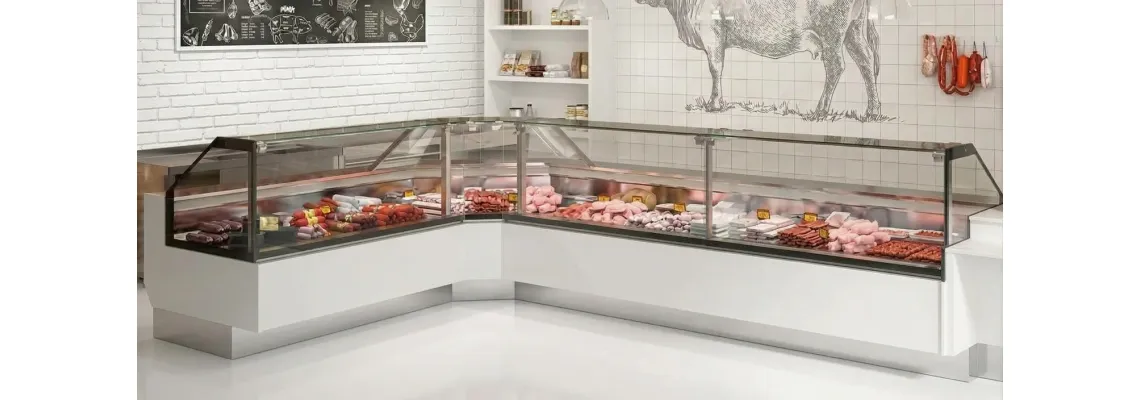
Commercial display cases · Buying guide
Meat and fish display cases: how to choose, which lighting sells, and when to go for remote or plug-in refrigeration
Meat and fish are the two most sensitive products on a shop or deli counter. They need different temperatures, humidity, light and even different materials inside the case. In this article we look at each type separately — what matters for meat and what matters for fish. Then we compare lighting and customer comfort, explain the difference between plug-in and remote refrigeration, and show how proper maintenance keeps a display case working for years.
+1…+4 °C
in a fresh meat display, even lower for minced meat
0…+2 °C
for fresh fish on an ice bed
2 cooling types
plug-in or remote — the choice determines noise, heat in the sales area and costs
In this article
- Why meat and fish need a specialised display case
- Meat display cases: what matters
- Fish and seafood display cases: what matters
- Meat vs fish: comparison in one table
- Lighting: what sells meat and what sells fish
- Comfort for customers and staff
- Plug-in or remote refrigeration
- Choosing in 6 steps
- Service, maintenance and spare parts
- Models in the YOUR HORECA range
- Frequently asked questions
01Why meat and fish need a specialised display case
A standard refrigerated display is designed for packaged products: drinks, dairy, ready salads. Fresh meat and fish are often displayed unpackaged, and that's where the problems start. Airflow dries them out, the wrong light changes their colour, and for fish, melting ice and salt damage the materials of an ordinary display case.
Temperature
Humidity
Light
Hygiene and materials
02Meat display cases: what matters
Temperature by product group
| Product | Recommended display temperature | Notes |
|---|---|---|
| Fresh beef, pork, lamb | +1…+4 °C | The lower within this range, the longer the shelf life |
| Minced meat, offal | 0…+2 °C | The most sensitive products — place them in the coldest zone |
| Poultry | 0…+4 °C | Keep separate from other meat to prevent cross-contamination |
| Sausages, ham, smoked meats | +2…+6 °C | For packaged products a ventilated case also works |
| Frozen meat | −18 °C and below | Needs a separate freezer display, e.g. with a lifting front glass |
Static or ventilated cooling
This is the most important technical choice for a meat display. With static cooling, cold air flows slowly down from the evaporator without a fan. Air movement is minimal, so unpackaged meat doesn't dry out and keeps its colour. With ventilated cooling, a fan blows the air and the temperature is more uniform, but the meat surface dries faster.
Static → for unpackaged meat
- minimal air movement, meat keeps its moisture
- red colour and weight are preserved
- suits a butcher's serve-over counter
- products must be arranged correctly for even cooling
Ventilated → for packaged meat and sausages
- uniform temperature throughout the case
- fast temperature recovery after restocking
- suits self-service displays
- unpackaged meat dries quickly and darkens
Display surface and depth
The inside of a meat display must be stainless steel that withstands meat juices, frequent washing and disinfection. The depth of the display surface determines how much can be shown and how easily staff can reach it. In professional cases it is typically 800–900 mm. Deeper cases display more, but staff must still be able to reach the back row.
🔍 A fact from practice: why meat turns brown in the case
03Fish and seafood display cases: what matters
Temperature and the ice bed
| Product | Recommended temperature | Notes |
|---|---|---|
| Fresh fish (whole, fillets) | 0…+2 °C | Best on melting ice, which keeps temperature low and humidity high |
| Prawns, squid, mussels (chilled) | 0…+2 °C | In a separate zone or trays so liquids don't reach the fish |
| Live crustaceans and shellfish | +5…+10 °C | Need moisture, but not immersion in meltwater |
| Smoked, marinated, salted fish | +2…+4 °C | Usually packaged, a ventilated case is fine; follow the producer's instructions |
| Frozen fish and seafood | −18 °C and below | A separate freezer display or chest freezer |
The classic fish display is an ice bed: the case's refrigeration keeps the temperature low, while a 5–10 cm layer of ice on the display surface holds the fish. Melting ice cools the fish from below and keeps the environment moist, so eyes and scales stay glossy. Ice is usually topped up 2–3 times a day.
Ice bed
- naturally moist environment and natural look
- strong visual impact, drives impulse purchases
- needs an ice maker and regular topping up
- needs drainage for meltwater
Active cooling without ice
- stable temperature without managing ice
- less work for staff
- suits packaged and processed fish
- unpackaged fish needs extra humidity control
Materials, drainage and odours
A fish display works in an aggressive environment: water, salt and fish liquids. So the display surface and tub must be high-quality stainless steel, sloping to a drain outlet with a connection to the sewer or a collection container. The bottom and drain must be easy to wash, as fish residues quickly cause unpleasant odours throughout the shop.
For an ice bed, flake ice works best: it fits closely around the fish, doesn’t damage the delicate flesh and cools evenly. Ice cubes leave air gaps and can dent fillets. For ice production — see ice makers.
⚠ The most common mistake in a fish display
04Meat vs fish: comparison in one table
| Criterion | Meat display | Fish display |
|---|---|---|
| Temperature | +1…+4 °C (minced meat 0…+2 °C) | 0…+2 °C |
| Cooling type | Static for unpackaged, ventilated for packaged | Ice bed + static or active cooling |
| Humidity | High, so the meat doesn't dry out | Very high, provided by melting ice |
| Display surface | Stainless steel, flat or with trays | Stainless steel tub with slope and drain |
| Lighting | Warm LED that brings out red tones, UV-free | Cool white LED that brings out the gloss |
| Daily work | Arranging products, cleaning glass | Topping up ice, washing the drain and tub |
| Main risk | Colour loss and drying out | Odours, corrosion, fish sitting in meltwater |
05Lighting: what sells meat and what sells fish
Customers judge meat and fish with their eyes first. Lighting is one of the cheapest and most effective sales tools in a display case — but only if it's chosen correctly.
| Parameter | For meat | For fish | Why |
|---|---|---|---|
| Colour temperature | Warm white, about 2700–3500 K | Cool white, about 4500–6500 K | Warm light brings out the red of meat, cool light the silvery gloss of fish and the freshness of ice |
| Spectrum | Special “meat” LED with enhanced red | Spectrum with enhanced blue and white | Special lamps make the product look naturally appealing |
| Colour rendering (CRI) | High, ideally 90+ | High, ideally 90+ | The customer sees the real colour and trusts the product |
| Heat and UV | UV-free, minimal heat | UV-free, minimal heat | Heat and UV speed up colour loss in meat and spoilage in fish |
| Lamp type | LED | LED | Old halogen and fluorescent sources heat the product and use more energy |
💡 Honesty matters more than effect
LED fixtures last a long time, but in a cold, humid environment they gradually lose brightness and can shift colour. If the light has become dim or uneven, it’s time to replace the fixtures — see lamps and bulbs.
06Comfort for customers and staff
A good display case is comfortable on both sides: the customer must see and choose the product easily, and staff must serve quickly and keep it clean easily.
Glass
Viewing height and angle
Price labels
Staff side
Cleaning
Noise and heat in the sales area
07Plug-in or remote refrigeration
In a plug-in display, the compressor and condenser are built into the case itself — you plug it in and it works. A remote display contains only the evaporator and controls; cooling comes from an external condensing unit or central refrigeration system located in a plant room or outside the building, connected to the cases by pipework.
| Criterion | Plug-in | Remote (central) |
|---|---|---|
| Installation | Simple: plug into a socket | Needs pipework, a condensing unit and a certified refrigeration technician |
| Initial cost | Lower for one or two cases | Higher, but pays off with many cases |
| Heat and noise in the sales area | Compressor heats the room and makes noise | Quiet in the sales area, heat is rejected outside |
| Energy use | Good for a small department | More efficient for a larger system; heat can be recovered for heating or hot water |
| Relocation | Easy to move or re-plan | Difficult to move, pipework must be rebuilt |
| Impact of a failure | Only one case stops | A unit failure can stop several cases at once |
| Refrigerant | Often natural propane (R290) | Increasingly CO2 (R744) or other natural refrigerants |
| Best for | Deli department, butcher's shop, small fish counter, temporary setups | Supermarkets, several cases in a line, shops with cold rooms |
✔ Refrigerants and the EU F-gas Regulation
✎ What it looks like in practice
08Choosing in 6 steps
- Define your range. Fresh unpackaged meat, packaged meat products, fresh fish on ice or frozen products — each has its own display type.
- Choose the cooling type. Static for unpackaged meat, ventilated for packaged products, an ice bed with drainage for fresh fish.
- Calculate length and depth. How many product types will you show at once? The layout and staff reach set the maximum depth.
- Decide on refrigeration. One or two cases — usually plug-in. Several cases in a line or a supermarket — consider remote.
- Choose lighting and glass. Warm spectrum for meat, cool for fish, UV-free LED. Heated glass for humid rooms.
- Ask about service before you buy. Are spare parts available locally? Does the service also handle central refrigeration systems? How fast does a technician arrive?
09Service, maintenance and spare parts
A meat or fish display that stops on a Saturday morning means stock written off and an empty counter for the weekend. Regular maintenance prevents most such situations.
YOUR HORECA service
Diagnostics, repair and maintenance of display cases and refrigeration systems
24/7
customer service
+371 25 522 233
On site
mobile service in your shop or restaurant, diagnostics and repair on the spot
In stock
fans, thermostats, compressors, evaporators and lighting at our warehouse in Riga, Vagonu iela 23
Maintenance contracts
scheduled maintenance that prevents breakdowns and makes costs predictable
YOUR HORECA service handles both plug-in display cases and refrigeration equipment connected to central systems. About YOUR HORECA service →
Maintenance schedule
| When | Meat display | Fish display |
|---|---|---|
| Daily | Clean the display surface, trays and glass; check the temperature | Replace or top up ice, wash the tub, check the drain |
| Weekly | Disinfect the interior, clean air vents and rear seals | Flush the drain, remove salt deposits from metal parts |
| Monthly | On plug-in units, clean dust from the condenser | Same + check the drain heater so the drain doesn't freeze |
| Every 6–12 months | Service visit: refrigerant pressure, fans, defrost, electrical connections | Same + corrosion check and seal inspection |
Most frequently replaced parts
Fans
Thermostats and controllers
Compressors
Evaporators
Lighting
Seals
✎ What it looks like in practice
⚠ Safety and hygiene
Display case temperatures can also be monitored automatically, without a paper log. For storage temperature requirements, see Food storage rules in the refrigerator; for other shop displays, see our article on pastry and shop display cases.
10Models in the YOUR HORECA range
We offer more than 20 meat display models (TEFCOLD, IGLOO) and more than 15 fish and seafood display models (IGLOO, JUKA). A few examples:
Refrigerated display SPID100 (TEFCOLD)
Compact display for a small butcher or deli. Also available in 1300, 1500, 2000 and 2500 mm.
€2,989.00 excl. VAT
View →Refrigerated display SOCB12582A (TEFCOLD)
825 mm deep stainless steel display surface for prepared food, meat and sausages.
€4,279.00 excl. VAT
View →Refrigerated display SOCA12590A (TEFCOLD)
Premium serve-over display with a 900 mm deep display surface. Also in 1870 and 2500 mm.
€4,999.00 excl. VAT
View →Freezer display SANTIAGO M 1680 mm (IGLOO)
Freezer display with a telescopic front glass lifting system for easy cleaning and restocking.
€3,999.00 excl. VAT
View →IGLOO fish displays (TATIANA2, SANTIAGO S2, LUZON)
Displays for fresh fish and seafood with ice-bed presentation and drainage.
On request
View →JUKA fish displays (MODENA, SEVILLA, HAWANA)
Serve-over displays for fish and seafood in various lengths and styles.
On request
View →Prices excl. VAT as of October 2026 and subject to change. All models in meat display cabinets and fish and seafood displays. See also retail display cabinets.
11Frequently asked questions
Can meat and fish be displayed in the same case?
Better not. Meat and fish have different ideal temperatures, humidity and lighting, and there's a cross-contamination risk. If space is limited, use a case with physically separated zones and separate trays — but two cases are the best solution.
Why does meat darken quickly in the display?
The most common causes are ventilated cooling for unpackaged meat, too high a temperature, and unsuitable lighting that heats or emits UV. Static cooling, a stable +1…+4 °C and UV-free LED fixtures significantly extend the meat's appealing look.
How often should the ice in a fish display be changed?
Ice is usually topped up 2–3 times a day and fully replaced daily. In the evening, the fish is moved from the ice bed to a cold room, and the display is washed and the drain cleaned.
When is remote refrigeration more cost-effective?
Usually when there are several refrigerated displays in one sales area, or cold rooms as well. A central system removes noise and heat from the sales area and uses less energy over time. For one or two cases, plug-in is usually simpler and cheaper.
Which lighting is better for fish?
Cool white LED with high colour rendering, which brings out the gloss of scales and the freshness of the ice. Avoid warm, yellowish light, under which fish looks old, and sources that heat the product.
Why does a fish display need a drain heater?
The meltwater drain sits in a cold zone and can freeze. The heater keeps it open so water doesn't collect in the tub. If the tub starts overflowing, check the drain heater first.
Does YOUR HORECA service displays not bought from us?
Contact customer service on +371 25 522 233 and give the display’s manufacturer, model and whether it runs on plug-in or remote refrigeration. We’ll help find the fastest solution and the spare parts you need.
Planning a meat or fish counter?
Tell us about your range, space and volume — we'll help choose the display type, lighting and refrigeration solution, deliver it and provide service and spare parts.
Temperature, lighting and maintenance figures are indicative and based on industry practice and typical manufacturer specifications. Operating rules for specific equipment are set by the manufacturer's manual; storage limits are set by your self-control (HACCP) plan.