

Electromechanical equipment · Buying guide
Planetary mixer or spiral dough mixer: which to choose, and why a pizzeria, pastry shop, canteen and restaurant each need a different one
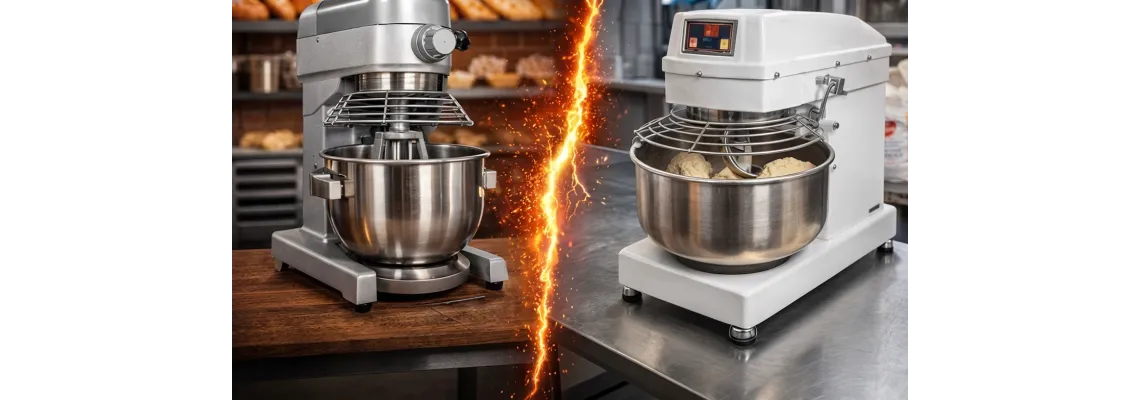
From the outside the two machines look alike — a bowl, a motor, a rotating tool. In practice they solve completely different problems. The wrong choice means either overheated pizza dough and a broken gearbox, or an expensive dough mixer that cannot even whip cream. In this article: how each machine works, how much dough it can really handle, how to choose by your menu, and how to look after it so it lasts for years.
1.5–2×
more dough in a spiral mixer than in a planetary mixer with the same bowl size
~60%
of maximum load — the safe limit for stiff dough in a planetary mixer
24–26 °C
the ideal dough temperature after mixing for most yeast doughs
In this article
- The short answer: which one and when
- How each machine works
- Comparison in one table
- How much dough you can really mix
- Dough temperature — the invisible quality factor
- Pizzeria, pastry shop, canteen, restaurant: what suits whom
- Other mixer types worth knowing
- Choosing in 6 steps
- Service, spare parts and maintenance
- Models in the YOUR HORECA range
- Frequently asked questions
01The short answer: which one and when
If your kitchen's main product is yeast dough in large quantities — pizza, bread, bagels, dumplings — you need a spiral dough mixer. If dough is just one of many tasks and every day you whip, beat and blend, you need a planetary mixer. If both matter, the best solution is almost always two machines rather than one “universal” one.
Spiral mixer if…
- you mix yeast dough every day, several batches
- the dough is wet (65–80% hydration) or long-fermented
- a batch is 5 kg or more
- stable dough temperature and elastic gluten matter
Planetary mixer if…
- you whip cream, egg whites, meringue
- you make creams, sponge, cake and cookie batters
- you blend purées, fillings, minced meat, sauces
- dough is a small batch, not your core product
02How each machine works
Planetary mixer: moving like a planet around the sun
The bowl stays still while the tool spins on its own axis and at the same time travels around the inside of the bowl. That way it reaches every part of the bowl with no “dead zones”. Three tools usually come as standard, each with its own job:
- Whisk — incorporates air: whipped cream, egg whites, meringue, sponge batter, soufflé.
- Flat beater (paddle) — mixes and emulsifies: buttercreams, cake and cookie doughs, mashed potatoes, meatball mixtures, fillings.
- Dough hook — for small batches of yeast dough.
Many professional models also have an attachment hub for a meat mincer, vegetable slicer or pasta attachment. That is why in a canteen a planetary mixer often replaces several separate machines.
Spiral mixer: imitating kneading by hand
Here both the bowl and the spiral hook rotate, while a stationary breaker bar stands in the centre of the bowl. The dough is stretched between the spiral and the bar, folded and stretched again — exactly how a baker kneads by hand. At any moment the spiral works only part of the dough while the rest “rests” and turns with the bowl. As a result the dough heats up less and the gluten network develops evenly.
There are usually two speeds: first for combining and hydrating ingredients, second for developing gluten. In a typical spiral mixer the spiral turns at around 160 rpm and the bowl at around 15 rpm. Models come with a fixed or removable bowl and a fixed or tilting head.
A fact only practitioners know
03Comparison in one table
| Criterion | Planetary mixer | Spiral mixer |
|---|---|---|
| Main task | Whipping, beating, blending, small doughs | Kneading yeast dough |
| What moves | The tool (bowl stays still) | Bowl and spiral |
| Tools | Whisk, beater, hook + attachments | Spiral and breaker bar |
| Dough capacity | Limited, depends on dough moisture | 1.5–2× more in the same bowl size |
| Dough heating | Higher — whole mass worked continuously | Lower — only part of the mass worked |
| Very wet dough (75%+) | Difficult, dough climbs the hook | Excellent |
| Creams, meringue, purées | Yes | No |
| Speeds | 3–15 steps or stepless | Usually 2 |
| Safety standard | EN 454 (planetary mixers) | EN 453 (dough mixers) |
| Typical place | Pastry shop, canteen, restaurant, hotel | Pizzeria, bakery, dumpling production |
04How much dough you can really mix
This is where people go wrong most often. Bowl litres are not dough kilograms, and a “20-litre” planetary mixer does not mean you can mix 20 litres of pizza dough in it.
The key concept: absorption ratio (AR)
Manufacturers rate mixer capacity by dough moisture, expressed as the absorption ratio: water weight divided by flour weight. If a recipe uses 6 kg of flour and 3.6 kg of water, the AR is 60%. The less water, the stiffer the dough and the greater the load on the motor and gearbox.
- Most manufacturers' capacity charts are based on 60% AR dough.
- For dough at 40% AR (thin pizza dough, bagels), reduce the batch by about one third.
- With strong (high-gluten) flour, reduce the batch by a further ~10%.
- With chilled flour, iced water or ice — another ~10% less.
- Mix stiff dough (below 50% AR) in a planetary mixer in first speed only; never mix dough above second speed.
| Bowl size | Spiral mixer (dough) | Planetary mixer (dough, ~60% AR) | Planetary (stiff dough, ~40–50% AR) |
|---|---|---|---|
| 10 L | up to ~6–6.5 kg | ~3–4 kg | ~2–2.5 kg |
| 20–22 L | up to ~13–18 kg | ~8–9 kg | ~4–5 kg |
| 30–33 L | up to ~20–25 kg | ~12–13 kg | ~6–7 kg |
| 40–42 L | up to ~30–38 kg | ~18–20 kg | ~9–10 kg |
Indicative figures based on typical manufacturer specifications. Always check the maximum for your specific model in its manual. For example, a manufacturer may rate a 20-litre professional planetary mixer at 6 kg of flour at 50% water — roughly 9 kg of finished dough.
⚠ Why planetary mixers break most often
A simple bowl-size calculation for a spiral mixer: 1 kg of dough takes up roughly 1.5–2 litres of bowl volume. Add 25–40% headroom for seasonal peaks and you have your real size.
05Dough temperature — the invisible quality factor
Friction warms the dough during mixing. If the dough is too warm after mixing, the yeast works too fast, the flavour turns flat and long cold fermentation becomes unpredictable. For most yeast doughs the ideal temperature after mixing is 24–26 °C, and 26 °C is a limit best not exceeded.
This is where the two machines differ most. A planetary mixer works the entire mass continuously against a stationary bowl, so it generates more friction heat. A spiral mixer works only part of the dough at any moment, so the dough warms more slowly. For a pizzeria using 48–72-hour fermentation, that is decisive.
✔ How bakers control dough temperature
Water temperature = (desired dough temperature × 3) − (flour temp. + room temp. + friction factor)The friction factor is how many degrees your particular machine adds during mixing. Measure it once: record flour, room and water temperature, mix a batch and measure the finished dough. The difference shows your mixer's “character”. For a planetary mixer it is usually considerably higher than for a spiral mixer.
Indicative mixing times: in a spiral mixer typically 3–5 minutes in first speed and 5–8 minutes in second. In a planetary mixer the same dough takes longer, often 15–20 minutes in total, which warms it even more.
06Pizzeria, pastry shop, canteen, restaurant: what suits whom
The choice depends not on what the business is called but on what the kitchen makes most. Below are typical situations we meet when equipping HoReCa kitchens.
Pizzeria → spiral mixer
In practice: 80–120 pizzas a day = about 20–30 kg of dough. A 22–33 litre mixer and two batches are enough.
Pastry shop → planetary mixer
In practice: there are often two mixers — a large one (20–40 L) for base mixtures and a small one (5–10 L) for creams and decoration. If the shop also bakes bread or croissants, a small spiral mixer alongside is useful.
Canteen → large planetary mixer
In practice: a 40–60 litre mixer prepares cake or pancake batter for 200–400 portions in one cycle.
Restaurant → depends on the menu
- Bread and desserts bought in — a small bench-top planetary mixer (5–10 L) for desserts, sauces and purées is enough.
- Own bread or pizza — you need a spiral mixer (10–22 L), because dough quality ends up on the plate.
- Both important — two machines. Trying to do both with one ends in a compromise on quality or a repair.
| Business | Main machine | Typical size | Additional machine |
|---|---|---|---|
| Pizzeria | Spiral mixer | 15–42 L | Small planetary for desserts (if needed) |
| Bakery | Spiral mixer | 40–130 L+ | Planetary for pastry, bowl lifter |
| Pastry shop | Planetary mixer | 10–40 L | Second small planetary; spiral if baking bread |
| Canteen, school, hospital | Planetary mixer (floor) | 30–60 L | Mincer / vegetable slicer attachment |
| Restaurant | Depends on the menu | 5–22 L | Often both machines |
| Hotel (breakfast, banquets) | Planetary mixer | 20–40 L | Spiral if baking own bread |
| Café | Bench-top planetary mixer | 5–10 L | — |
✎ What it looks like in practice
07Other mixer types worth knowing
Twin-arm mixer
Fork mixer
Removable-bowl mixers
Bowl lifters
08Choosing in 6 steps
- Write down what makes up 70% of the work. Dough — spiral mixer. Everything else — planetary mixer. Equal — two machines.
- Calculate your largest batch in kilograms. Choose a spiral mixer by dough weight (1 kg ≈ 1.5–2 L of bowl). For a planetary, check the manufacturer's capacity chart for your dough's AR.
- Assess the intensity. A couple of times a week, or all day every day? Intensive work needs a professional model with metal gears and a robust motor, not a semi-professional one.
- Check power and space. 230 V or 400 V, bench-top or floor model, room to remove and clean the bowl, floor load capacity for large models.
- Choose the controls. Mechanical gearboxes are durable, but speed is changed only with the machine stopped. An electronic variator (inverter) lets you change speed while running and gives finer control.
- Ask about service before you buy. Are spare parts available locally? How fast does a technician arrive? Is a maintenance contract possible? A cheap mixer without service can cost more than a quality one with local support.
💡 Tip for a new business
09Service, spare parts and maintenance
A mixer that stops on a Friday evening costs not only the repair but also the pizzas not baked and the cakes not made. Regular maintenance is the cheapest way to avoid downtime in the middle of the season.
YOUR HORECA service
Diagnostics, repair and maintenance of planetary and spiral mixers
24/7
customer service
+371 25 522 233
On site
mobile service in your kitchen, diagnostics and repair on the spot
In stock
a wide range of spare parts at our warehouse, Vagonu iela 23, Riga
20+ years
of experience supplying and servicing HoReCa equipment
We also offer long-term maintenance contracts: scheduled inspections, adjustment, safety checks and timely parts replacement. This makes costs predictable and prevents breakdowns. About YOUR HORECA service →
Most frequently replaced parts
Working tools
Drive
Seals and oil
Safety switches
Electrics and controls
Motors
When ordering parts, always give the manufacturer, model and serial number from the machine's rating plate. Use original or manufacturer-approved parts. All spare-part categories — YOUR HORECA spare parts.
Maintenance schedule
| When | What to do | Who |
|---|---|---|
| After every use | Clean the bowl, tools, guard and housing. Don't let dough dry on. | Staff |
| Daily | Check the tool doesn't touch the bowl, the whisk has no bent wires, and the guard stops the machine. | Staff |
| Weekly | Remove dough residue around the shaft and bowl mount; check the cable and plug. | Staff |
| Every 6 months | Belt tension and wear, bearing noise, grease condition, safety switch check. | Service |
| Annually | Full technical service: gearbox oil (where applicable), seals, electrical connections, insulation test. | Service |
⚠ Safety first
Signs you need service
- Unusual noise, knocking, whistling or whining.
- Belts slip, speed drops under load.
- The machine vibrates or “walks” across the bench.
- The motor or housing overheats, a burning smell.
- Oil or grease appears around the shaft or in the bowl.
- The tool starts touching the bowl, the bowl won't lock or the lifter moves unevenly.
- The machine switches itself off or won't start after the guard is closed.
✎ What it looks like in practice
10Models in the YOUR HORECA range
We offer more than 100 planetary mixers and more than 100 dough mixers — from 5-litre bench-top models to industrial 400-litre machines. A few popular examples for different tasks:
Spiral dough mixer 15 L IFM15 (PIZZA GROUP)
Spiral mixer. Bowl, spiral and breaker bar in AISI 304 stainless steel. The grid lets you add ingredients while running.
€939.00 excl. VAT
View product →Spiral dough mixer 22 L IF22 (PIZZA GROUP)
Spiral mixer for a mid-size pizzeria or a restaurant baking its own bread. Two-speed versions also available.
€1,099.00 excl. VAT
View product →Dough mixer 38 kg / 42 L
Spiral mixer with removable traverse and fixed bowl for various doughs in larger batches.
€1,710.00 excl. VAT
View product →Planetary mixer 6.9 L PROFESSIONAL (KitchenAid)
All-metal construction, bowl-lift mechanism, 0.5 kW. For desserts, creams and sauces in small quantities.
€990.91 excl. VAT
View product →Planetary mixer 20 L BP-20 (SAMMIC)
Three-phase motor with inverter, runs from a single-phase socket. Electronic speed control, double safety microswitches.
€3,389.00 excl. VAT
View product →Planetary mixer BULL B40L
40-litre floor model for doughs, egg whites, cream and sponge in large volumes.
€4,931.00 excl. VAT
View product →Prices excl. VAT as of October 2026 and subject to change. See all models in the electromechanical equipment category.
11Frequently asked questions
Can I make pizza dough in a planetary mixer?
Yes, but in small batches and at reduced load. For thin, low-moisture pizza dough, reduce the batch by about a third of the manufacturer's chart figure and mix in first speed only. If pizza is your core product and you mix every day, a spiral mixer pays for itself with better dough and a longer machine life.
Can a spiral mixer whip cream or egg whites?
No. A spiral mixer has no whisk, and its motion is designed only for stretching and folding dough. For creams, meringue and sponge you need a planetary mixer.
How big a mixer does a pizzeria making 100 pizzas a day need?
One 30–32 cm pizza uses about 230–280 g of dough, so 100 pizzas need about 25–28 kg of dough a day. That is easily mixed in a 22–33 litre spiral mixer in two batches. A larger mixer allows a single batch, but remember the minimum load on quieter days.
Why is my dough too warm after mixing?
The most common reasons: mixing too long, water or room too warm, and the higher friction of a planetary mixer. Calculate the water temperature with the formula in section 5, use cooler water in summer and don't mix longer than needed. If the problem recurs daily, the machine type may not match your volume.
Can I change speed while the mixer is running?
It depends on the drive. On mixers with a mechanical gear transmission, change speed only with the machine stopped, otherwise the gears wear quickly. On models with an electronic variator (inverter) you can change speed while running. Always check your machine's manual.
How often is professional maintenance needed?
For an intensively used machine — ideally every 6 months; for others — at least once a year. Maintenance covers belts, bearings, seals, grease, safety switches and electrical connections. With a maintenance contract you don't have to remember — the service schedules the visits.
Does YOUR HORECA repair mixers not bought from us?
Contact customer service on +371 25 522 233 and give the machine's manufacturer and model. Our service handles planetary and spiral mixers, and we will help you find the fastest way to get your equipment working again.
Not sure which machine suits your kitchen?
Tell us your menu and daily volume — we will help you choose the right type and size, deliver it and provide service and spare parts for the machine's whole life.
Capacity, temperature and maintenance figures are indicative and based on typical manufacturer specifications and industry practice. Operating rules for specific equipment are set by its manufacturer's manual.