

CANTEEN EQUIPMENT · YOUR HORECA GUIDE
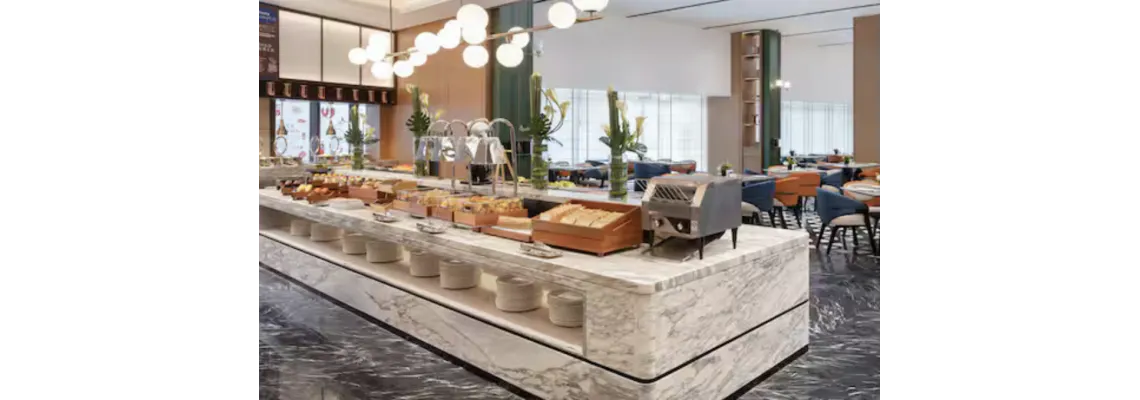
The canteen serving linebain-maries, DROP-IN modules and self-service display units
The serving line is where the kitchen’s work either reaches the guest hot and appetising, or cools down in the queue. This article explains what a modern canteen line is made of, when to choose free-standing bain-maries and when DROP-IN built-in modules, how to size the line by the number of guests, and what HACCP requires.
A school canteen has to feed 300 pupils in 40 minutes. In a factory one shift follows another and the lunch break is 30 minutes. Under those conditions the serving line is not a piece of furniture — it is production equipment whose throughput, temperature stability and ergonomics directly decide how many people get fed, and how well.
A well-planned line works invisibly: the food is hot down to the last portion, the salads have not wilted, staff are not walking off to find a missing GN container, and the queue moves evenly. A badly planned line produces the opposite — a bottleneck at one module, lukewarm food, and a HACCP log whose figures do not match reality.
THE YOUR HORECA DESIGN OFFICE
You are not picking individual appliances — you receive an engineered line
We develop the canteen serving line from the first site measurements to commissioning: the technical solution, 3D, 4D and 5D models, photorealistic visualisation, manufacturing and on-site installation. You see your own line before it is built — together with its cost and the installation schedule.
01What a modern serving line consists of
A modern canteen equipment system is modular: the line is assembled from separate segments, each with its own temperature function. That makes it possible to fit the configuration to the room and the menu, and to extend it later without replacing the whole counter.
Hot modules
Hot bain-maries, heated surfaces and hot display units for the main course, side dishes, sauces and soups.
Cold modules
Refrigerated bain-maries, chilled surfaces and salad bars for salads, desserts and dairy products.
Neutral modules
For bread, pre-packed items, trays and the till area. Often also the place where the line “breathes” between the hot and the cold segment.
Load-bearing structure
Serving and distribution counters and counters built from furniture modules, into which the DROP-IN appliances are fitted.
Protection and ergonomics
Sneeze guards, tray slides, an overhead bridge shelf and lighting.
Logistics
Tray trolleys, plate trolleys and mobile modules for seasonal or event loads.
Plan the line in the direction the guest moves: trays and cutlery → cold starters and salads → soup → main course and side dishes → dessert and drinks → till. In a canteen serving 300 people, every step taken back against the flow costs several minutes in every shift.
02How long the line should be — sizing it by guest numbers
The starting point is always two figures: how many guests must be served, and in how many minutes. From them follows the required throughput, and from the throughput the number of modules and the length of the line. In practice one self-service segment is 100–120 cm wide, and a functional line starts at two segments.
| Type of site | Guests per shift | Recommended configuration | Approximate length |
|---|---|---|---|
| Small canteen, office | up to 80 | 1 hot bain-marie (2–3 × GN 1/1) + 1 cold module + neutral till area | 2.5–3.5 m |
| School canteen | 150–300 | Hot bain-marie 4 × GN 1/1 + soup section + salad bar + neutral module | 4–6 m |
| Factory, shift work | 200–400 | Hot zone 5–6 × GN + cold zone + mobile modules for peak shifts | 6–8 m |
| Large corporate canteen | 400–600 | Two parallel lines or free-flow islands with a separate till area | 2 × 6 m or islands |
| Hospital | staff + visitors | Combined hot/cold line with enhanced labelling and disinfectable surfaces | 4–6 m |
The second key dimension is the width of the queue: the self-service aisle facing the line needs at least 1.2 m, and 1.6–1.8 m if other guests also have to pass along it. In social-care institutions and in schools with an inclusive environment, at least one segment must have a lowered working surface for wheelchair users.
03Bain-marie: water bath or dry heat
The bain-marie is the heart of the line. Choosing between a water bath and dry heating is not a matter of taste — it depends on what you serve. The wrong type of heat ruins the texture faster than the staff will notice.
| Criterion | Water bath (bain-marie) | Dry heat (dry) |
|---|---|---|
| Suited to | Soups, sauces, stews, purées, porridges | Roast meat, patties, fries, gratins, baked goods |
| Character of the heat | Gentle, even, does not scorch the edges | Faster, preserves the crust and crispness |
| Risk | Moisture softens crisp products | Liquid dishes dry out and form a skin |
| Daily work | Water has to be topped up and drained, the level watched | No water — faster preparation and cleaning |
| Temperature | Adjustable, roughly +30…+90 °C | Adjustable; surface models up to +80…+105 °C |
For a varied menu the most practical answer is a combined line: a water-bath section for soups and sauces next to a dry-heat section for fried products. Both versions are available in the YOUR HORECA range, free-standing as well as built-in.
A bain-marie holds temperature; it does not heat the product up. Food must arrive at the line already heated to at least +75 °C — only then can the unit keep it above +65 °C for the whole serving period. “Warming up” cold food in a bain-marie is both a quality and a food-safety mistake.
04DROP-IN modules — when to build the appliance into the counter
A DROP-IN, or built-in, module is set into a cut-out in the counter top. Only the rim of the appliance and the GN containers remain visible — no separate housing, legs or gaps. That is the difference between “an appliance placed on a counter” and a single, engineered line.
Hot DROP-IN bain-maries
Water-bath or dry-heat modules for 2–6 GN containers, with a common tank or a separate chamber for each GN.
Hot DROP-IN surfaces
A heated flat surface for plates, tureens and serving dishes, with no GN restriction.
Cold DROP-IN bain-maries
Refrigerated wells for salads, desserts and dairy products — built into existing counters.
Cold DROP-IN surfaces
A chilled flat surface that takes any kind of dish — a flexible solution for buffets.
When DROP-IN is the right choice
- You already have a good counter or furniture module system and only the function needs adding.
- Appearance matters — the canteen is in a representative area of an office or hotel.
- You need a bespoke length or an unusual shape (L-shaped, islands, corner solutions).
- You want to mix functions in one counter: hot + cold + neutral segment with no visible joints.
When a free-standing module is better
- The budget is limited and there is no counter yet — a ready-made bain-marie with its own housing costs less than a counter plus the fitting work.
- Mobility is required — for example mobile modules for events or a seasonal terrace.
- The premises are rented and the equipment has to move with you.
The size of the counter cut-out must be matched to the technical data of the specific model before the furniture is manufactured — not afterwards. You also need to allow for the electrical supply (230 V or 400 V depending on the rating), a drain outlet for water-bath models, and ventilation for the condensing unit of cold modules. Insufficient airflow under the counter is the single most common cause of premature failure in a cold DROP-IN module.
05The cold zone: salads, desserts and dairy
The cold zone is where HACCP non-conformities appear most often, because a salad bar works with an open surface in a warm room. In practice that means two rules: the cooling must be ventilated (not merely static), and GN containers must not be filled above the rim line — otherwise the top layer gets no cold at all.
The standard working range for cold modules is +2…+8 °C, and that is exactly what has to be recorded in the monitoring log. Salad bars with an upper display section additionally protect the products from room heat and from guest contact.
Put already-chilled products into a cold bain-marie. Room-temperature salads absorb the whole capacity of the module, and for the first half hour the entire well stays too warm — including the products that were already in it.
06Self-service display units — complete line systems
If you would rather not assemble a line from individual elements, the answer is a complete self-service display unit system. In these, the hot, cold and neutral segments are already designed as one family — the same height, design, sneeze guards and lighting — and can be joined into one continuous counter.
BUFFET
Buffet modules with a neutral, heated or refrigerated surface and integrated LED lighting.
KIDS
A lowered, colourful line for kindergartens and primary schools — accessible to the youngest.
07Sneeze guards, tray slides and the rest of the “small” items
These are the elements most often added at the end of a project and just as often forgotten in the budget, even though they determine whether the line really is comfortable to work with.
- Sneeze guard — mandatory in a self-service area. It protects the food from guests’ breath and touch; available straight, angled or adjustable.
- Tray slide — without it the guest holds the tray in their hands and the queue slows down. Standard depth 30–35 cm.
- Heated bridge shelf — an overhead warming-lamp section lets you leave the food uncovered while holding its temperature from above.
- A set of GN containers — count on at least two sets: one on the line, one in the wash-up or ready for refilling.
- Tray trolleys and fittings — cutlery cassettes, napkin holders, price holders and allergen labelling stands.
08HACCP: what inspections actually look at
The serving line is a critical control point — it is the last place where food can either be protected or spoiled. In practice, supervision pays attention to these things:
Hot food ≥ +65 °C, cold food ≤ +8 °C. Measurements must be taken with a probe thermometer in the product itself, not merely read off the appliance display, and entered in the log for every serving period.
Food in a bain-marie is not meant to stand for hours. Set a maximum time for each dish and never top up a new portion on top of the old one — replace the GN container completely.
The water must be changed daily and the well drained and disinfected. Water standing warm for long periods is a risk environment, which is why a bain-marie must have an accessible drain tap.
A separate serving utensil for every GN container, the sneeze guard at the correct height, and clear allergen labelling at every position.
Calibration of thermostats and sensors, inspection of heating elements, condition of the door seals. If the appliance shows +70 °C but the probe in the product reads +58 °C, the problem has to be solved by a service engineer, not written into the log.
All YOUR HORECA line working surfaces and wells are AISI 304 stainless steel — seamless, resistant to professional disinfectants and easy to clean. It is the only material that withstands 10+ years of daily canteen-line duty without losing its appearance.
09Daily care — ten minutes that extend the service life
- Before the shift: switch the bain-marie on 20–30 minutes in advance so the well reaches working temperature. For a water bath, fill to the mark — the heating element must never run dry.
- During the shift: put the lids back on when a position is not in use, and watch the water level as it evaporates.
- After the shift: drain the water only once it has cooled, remove the GN containers, wash the well and wipe it dry. Never splash a hot well with cold water — the metal deformation is irreversible.
- Weekly: descale the water bath. The water in the Baltics is hard, and limescale on the heating element reduces its output and eventually burns it out.
- For cold modules: clean the dust off the condenser grille — a clogged condenser is behind roughly every second cooling fault.
Service, spare parts and fast response
A canteen line cannot “wait until next week”. If the bain-marie is dead in the morning, lunch still has to be served. That is why the YOUR HORECA service approach is built around a single principle — solve the problem the same day.
The spare parts most often needed for a serving line — heating elements, thermostats, compressors and control switches — are held in our spare parts catalogue. Ask our team about service and maintenance for your site.
10Solutions from the YOUR HORECA range
We supply canteen equipment from Stalgast, Novameta, ROCAM, Casselin and SAYL, alongside our own stainless steel structures. Below are typical line elements for different budgets.
Hot bain-marie 2 × GN1/1 with 2 taps
Stainless steel, 2 drain taps, capacity 2 × GN1/1 – 150 mm, adjustable thermostat. An entry-level solution for a small canteen or café.
View the category
Hot bain-marie 3 × GN1/1 with a common tank
Built-in module for GN1/1-200 mm containers, manual filling and draining. The basic configuration for a school line.
View the category
Drop-in hot bain-marie 1099 mm
Effective thermal insulation, remote control and a drain valve. A long built-in module for a professionally designed counter.
View the category
Hot bain-marie with dry heat DROP-IN 3 DRY
Static heating without water — for fried products that must keep their crust. Faster preparation and cleaning.
View the category
Buffet counter with a neutral surface BUN
The neutral segment with integrated LED lighting and an illuminated inner shelf. For bread, trays and the till area.
View the category
Cold buffet counter for GN containers BUF65
A refrigerated surface with a +4…+8 °C range for GN containers — salads, desserts and cold starters.
View the category
Prices are shown excluding VAT and were current at the time of publication. Please check the current price and availability on the product page or ask our team.
11Five steps from an idea to a working line
Number of guests, meal times, the size of the menu (how many positions at once), room dimensions and where the kitchen exit meets the line.
A linear line, an L-shaped solution or free-flow islands. Linear is the fastest with a uniform menu; islands work better when guests choose from several directions.
How many hot GN sections, how many cold ones, where the neutral segment and the till area go. This is also where the DROP-IN or free-standing decision is made.
Electrical rating and phases, water supply and drainage, ventilation for the cold condensing units. This step has to be agreed before the furniture is manufactured.
We prepare the canteen project with a 3D, 4D and 5D model — the look, the installation schedule and the cost estimate — agree it with you, and only then start manufacturing, delivery, installation and commissioning. More about this stage.
12Design, 3D–5D models and installation
This is the part of the YOUR HORECA service that separates an engineered line from a pile of appliances. A canteen line is almost never a standard product — every room has its own dimensions, columns, windows, doorways and building services. That is why we build the model first and manufacture only afterwards.
3D — what it will look like
A geometric model of the room and the line with every module, sneeze guard, tray slide and finish material. Photorealistic visualisation lets management and the client see the end result, walk the line from the guest’s viewpoint, and take design decisions while changes still cost nothing.
4D — when things will happen
A time schedule added to the model: production lead times, delivery, removal of the old line, phased installation and commissioning. This matters most at sites that cannot stop — schools during the summer break, or hospitals where catering has to run every day.
5D — what it will cost
Costs linked to the model: every module, accessory and work stage with its own line in the estimate. Change the configuration in the model and the effect on the budget is immediately visible — which lets you decide with figures rather than feelings, and is convenient for public procurement documentation too.
What the YOUR HORECA design service includes
- Site survey and measurements — measuring the room, recording existing services and available capacity.
- Flow and zoning solution — guest movement, staff work positions, how the kitchen exit relates to the line.
- Drawings and technical specification — cut-out dimensions for DROP-IN modules, connection points, drainage, ventilation.
- 3D visualisation and the 4D–5D model — appearance, schedule and cost in one document to sign off.
- Manufacture of bespoke elements — non-standard counters, corner modules and stainless steel structures made to the design.
- Delivery, assembly and commissioning — installation on site, connection, testing and staff training.
- Warranty and post-warranty service — maintenance and spare parts throughout the equipment’s life cycle.
A change in the model costs one e-mail. A change in a counter that has already been built costs a new part, transport and downtime. That is precisely why we do not start production before the client has approved the 3D view and the estimate — and precisely why installation on site usually takes a day or two rather than a week.
Take a look at our canteen projects and bespoke solutions.
13Frequently asked questions
How quickly does a bain-marie reach working temperature?
Usually in 15–30 minutes, depending on the rating and the starting temperature. Water-bath models take longer than dry heating, so switch the appliance on before loading the food, not together with it.
Can modules from different manufacturers be combined in one line?
Technically yes, but in practice heights, edge profiles and design differ, so the joints stay visible. If the line has to be built from different sources, the answer is a common counter with DROP-IN modules — then what is visible from the outside is one continuous surface.
Can the line be extended after a year or two?
Yes — that is the main benefit of the modular principle. It is worth allowing for spare electrical capacity and room for one additional segment in the original design; then extending it means adding a module rather than starting a new project.
How many sets of GN containers are needed?
At least two full sets for every position on the line: one in service, one in the wash-up or ready to swap in. In canteens running two shifts — three sets. It is the cheapest way to avoid pauses in service.
Is it possible to rent the equipment?
Yes, we offer equipment rental. It is a practical solution for events, for seasonal peaks, or for the period while the canteen is being refurbished.
Can I see my line before ordering?
Yes. We build a 3D model of the room and the line with photorealistic visualisation, and for larger sites a 4D (installation schedule) and 5D (cost) model as well. You approve the appearance, the deadlines and the estimate before production starts. See the design section.
Do you also carry out the installation on site?
Yes — delivery, removal of the existing line, assembly, connection, testing and staff training. We plan the work to the agreed schedule so that catering at the site is not interrupted for longer than necessary.
How long does a canteen line last?
An AISI 304 stainless steel structure lasts 10–15 years and more. The components wear out sooner — heating elements, thermostats, compressors and seals — but they are replaceable, and it is precisely the availability of spare parts that decides whether the line serves its full life.
Standard bain-maries and display units — 2–5 working days. Ask about delivery terms for your country.
Bespoke counters and modular sets — after the design is approved and within the manufacturing lead time.
We deliver across the Baltics and the rest of Europe — get in touch for a specific quotation.
Planning a new canteen line, or renewing an existing one?
Send us the room dimensions and the number of guests — our design team will prepare configuration options, a 3D visualisation, a 4D installation schedule and a 5D cost model, and will handle manufacturing, delivery and installation on site. We also advise on HACCP conformity and building-services requirements.
? +371 25 522 233 (customer service 24/7) · +371 29 519 851 · ✉️ [email protected] · ? Vagonu iela 23, Riga