

Extraction hoods and kitchen ventilation: sizing, filters, fire safety and maintenance
A hood is not a product you pick by width. It is part of a ventilation system that has to match your equipment's heat load, your make-up air, your duct velocities and the annual fire-safety inspection. This guide covers how to size the airflow, which filters to choose, how to look after them, and exactly what an inspector will ask for.
Why a hood on its own solves nothing
The most common mistake in a professional kitchen goes like this: buy a powerful hood, connect it to the existing duct and hope the steam disappears. A week later the kitchen is still damp, the doors swing shut by themselves, and the dining room smells of the grill. The hood is rarely the culprit.
Extract and supply are one system. If you pull 4 000 m³/h out of a room but only 500 m³/h comes back in a controlled way, the fan drags the remaining 3 500 m³/h in through doors, window gaps and neighbouring shafts. The room goes into heavy negative pressure, the hood's real capacity drops well below its rated figure, and instead of capturing steam it starts pushing it out along the edges. That is why sizing always starts with two numbers — what goes out and what comes back in.
- Air volume — matched to the heat and moisture load of the equipment, not to the room's cubic capacity.
- Pressure balance — controlled make-up air at 80–90 % of the extract, so the kitchen stays slightly negative relative to the dining room.
- Grease capture — filters that genuinely hold grease before the duct, because grease settled inside the duct is what burns.
Hood types and where each one belongs
The hood type follows the equipment layout, not personal taste. BHS carries a series for every layout.
| Type | Where it fits | BHS series | What to watch |
|---|---|---|---|
| Wall-mounted | Cooking line against a wall — the most common case | HNPA, HNPD, GREDIL box type | Three open sides — budget for a larger capture perimeter than you would expect |
| Island (central) | Free-standing cooking island in the middle of the room | HNCA, HNCD | Four open sides — needs roughly 30–40 % more air than a wall hood of the same area |
| With make-up air | Busy kitchens where extract exceeds 2 000 m³/h | HPPD, HPCD, HFPD and HFCD STHORM | Compensating air is delivered straight into the hood zone — cuts total energy use and draughts in the kitchen |
| Without filters (heat) | Dishwashers, kettles, steamers — steam and heat but no grease | HNPDC | No filters, so this extract must not join the same duct branch as the greasy extract |
| Condensate | Dishwash area, rack conveyor machines | HKCD with condensate plates | Catches condensate before it drips onto the floor and feeds mould growth |
| Low ceilings | Rooms under roughly 2,7 m, basement kitchens | GREDIL low-ceiling series, 1010–2010 mm | Slimmer body; keep the lower edge no lower than 1,9 m above the floor |
| Portable / recirculating | Demo kitchens, pop-ups, rooms with no route for a duct | Portable hood 2106 with activated carbon filter | Not a substitute for a duct — it removes odour but not heat or moisture |
Sizing the airflow: three methods
Three approaches are used in practice, from a quick figure in conversation to a full engineering calculation. The first two tell you the order of magnitude; the third is what goes into the drawings.
Method A — by hood area (quick estimate)
Example: a wall hood 2 000 × 900 mm → A = 1,8 m² → L ≈ 1 800 m³/h. Useful for checking whether the duct will cope at all, but it knows nothing about whether an induction range or a lava-rock grill sits underneath.
Method B — by capture velocity
| Cooking duty | Capture velocity v | Typical equipment |
|---|---|---|
| Light | 0.20–0.25 m/s | Steamers, kettles, bain-marie, convection oven |
| Medium | 0.25–0.35 m/s | Ranges, combi oven, fryer |
| Heavy | 0.35–0.50 m/s | Lava-rock grill, salamander, wok, pizza oven, griddle |
Method C — thermal calculation (EN 16282-1 / VDI 2052)
This is what real design work uses. Each appliance is assigned convective heat and moisture emission coefficients, a diversity factor is applied (equipment rarely all runs at full output at once), and the thermal plume reaching the lower edge of the hood is calculated. The result is typically 15–30 % leaner than Method A, because you stop paying to move air nobody ever moves.
Ballpark figures to open the conversation with, before the equipment data sheets are on the table:
| Appliance | Extract airflow | Note |
|---|---|---|
| Electric range, 4 plates (~10 kW) | 800–1 200 m³/h | Induction — lower end |
| Combi oven 6×GN 1/1 | 600–1 000 m³/h | A condenser connection reduces the requirement |
| Fryer 2×10 l | 700–1 000 m³/h | High grease-aerosol load — filters matter most here |
| Lava-rock grill, 800 mm | 1 200–1 800 m³/h | Additional fire-safety measures |
| Pizza oven (wood or gas) | 1 500–2 500 m³/h | Separate flue, not the shared extract |
| Griddle 800 mm | 900–1 400 m³/h | — |
| Dishwasher, hood type | 500–800 m³/h | Condensate hood, no grease filters |
| Dishwasher, rack conveyor | 1 000–1 800 m³/h | Often two extract zones — entry and exit |
Indicative values for initial planning. Final sizing follows the actual appliance data sheets and the diversity factor.
Line: induction range 4 plates + combi oven 6×GN + fryer 2×10 l + griddle 800 mm.
Raw extract total: 900 + 800 + 850 + 1 100 = 3 650 m³/h
Diversity factor 0.85: 3 650 × 0.85 ≈ 3 100 m³/h — that is the design extract.
Make-up air at 85 %: 3 100 × 0.85 ≈ 2 650 m³/h of controlled supply. The remaining 450 m³/h comes from the dining room — that is intentional and keeps the kitchen slightly negative so smells do not travel to guests.
Duct: 3 100 m³/h at 9 m/s → cross-section ≈ 0,096 m² → round duct Ø 350 mm or rectangular 400×250 mm.
Make-up air and pressure balance
Make-up air is the part of the design that gets cut first when budgets tighten. The outcome is predictable: the hood works at half strength, the heating cannot cope in winter, and the staff stand in a cold draught.
- Controlled supply air — 80–90 % of the extract volume.
- Kitchen held slightly negative relative to the dining room and corridors (roughly −5…−10 Pa) so odours do not spread.
- In winter the supply air must be tempered to at least 16–18 °C — otherwise the staff will simply shut it off.
- A hood with integrated supply (HPPD, HPCD, HFPD and HFCD series) delivers part of the compensating air directly at the hood — that air does not need heating to room temperature, which is a direct saving on the heating bill.
- A separate supply plenum (for example Z-HASP) is the answer when the hood is already installed but the balance does not add up.
Duct velocities and diameters
Air velocity in a grease duct is a fire-safety parameter, not just a noise question. Too slow and grease settles on the walls; too fast and you get noise and pressure loss.
| Section | Recommended velocity | Why |
|---|---|---|
| Face velocity at the filter | 0.8–1.2 m/s | Lower — poor capture; higher — droplets blow straight through the filter |
| Hood collar | 5–8 m/s | Even distribution along the whole length of the hood |
| Grease duct (main run) | 8–12 m/s | Below 5 m/s grease starts settling on the duct walls — a direct fire load |
| Clean extract (grease-free) | 5–8 m/s | Dishwash area, ancillary rooms |
| Supply duct | 3–5 m/s | Keeping noise down in the working zone |
Installation geometry — where it usually goes wrong
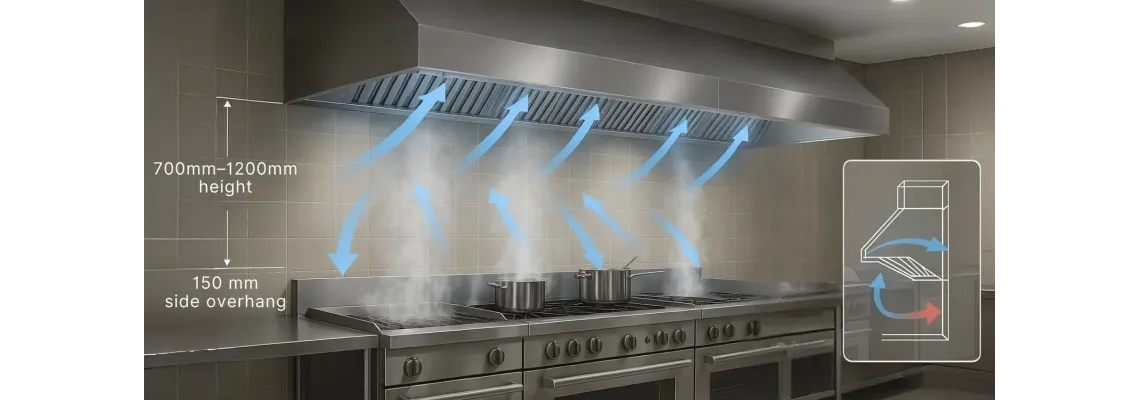
- Overhang: the hood must extend beyond the appliance outline by 150–300 mm on every open side. A hood cut «exactly to the range» guarantees steam escaping along the edges.
- Height: lower edge 1,9–2,1 m above the floor and 600–1 100 mm above the cooking surface. Every extra centimetre upward costs more air.
- Cross-draughts: keep the hood away from doors, supply grilles and fans — a cross-flow destroys the thermal plume and the steam goes past.
- Duct route: each 90° bend is worth roughly 3–5 m of straight duct in resistance. Two unnecessary bends can eat a tenth of the capacity.
- Access hatches: cleaning access is mandatory — at least every 3–4 m and at every bend. Without them the annual cleaning is physically impossible.
Filters: what actually holds grease back
A filter's job is not to make the air clean — it is to protect the duct. Every gram of grease that gets past settles on the duct wall and stays there until the next cleaning. That makes filter choice a fire-safety decision.
| Filter type | Material | Effectiveness | Maintenance | Where to use |
|---|---|---|---|---|
| Baffle | Stainless steel AISI 304 | High for large and medium droplets; works by inertial separation | Dishwasher-safe, lasts for years | The standard in a professional kitchen — the only correct choice over hot equipment |
| Mesh / cassette | Aluminium or steel mesh | Lower; clogs quickly | Washable but deforms | Light-duty zones only. Over a fryer or grill it is a fire hazard, because a grease-loaded mesh becomes the fuel |
| Condensate plates | Stainless steel | Catches moisture, not grease | Rinsing, condensate drain | Dishwash areas, steamers (HKCD series) |
| UV-C modules | Lamps inside the hood behind the baffle filter | Breaks down grease aerosol and odours | Lamp change ~8 000 h, regular cleaning | When the discharge is close to windows, a terrace or neighbours |
| Electrostatic | Ionisation section in the duct | Very high on fine particles | Regular plate washing; without it the effect disappears | Urban settings with strict odour limits |
| Activated carbon | Carbon cartridges | Odour only — not grease, not heat | Not washable — replace | Recirculating hoods only (e.g. the portable 2106), where no duct exists |
Inside a baffle filter the air is forced to change direction sharply several times. Grease droplets are heavier than air, cannot follow the turn and hit the plate, then run down into the collection channel and tap. A mesh filter instead accumulates the grease inside itself — and a saturated mesh above a fryer is precisely what ignites first. A baffle filter can be washed back to bare metal; a clogged mesh usually goes in the bin.
Maintenance: a schedule that actually works
Looking after a hood is not «a firm comes once a year». The annual system clean is a legal requirement, but the daily routine is what decides whether that clean is routine work or emergency repair.
| Frequency | What is done | By whom |
|---|---|---|
| Daily | Wipe down the hood's external surfaces and light glasses; empty the grease collection tray or open the condensate tap | Kitchen staff at the end of shift |
| 1–2× a week | Wash the baffle filters in the dishwasher at 60–65 °C with an alkaline degreaser; let them dry completely before refitting | Staff. Over fryers and grills — twice a week |
| Monthly | Clean the hood plenum behind the filters, the grease drain channel and the fan blades; check the lighting and the tap seal | Staff or service |
| Every 3–6 months | Inspect the first 2–3 m of duct through an access hatch; assess deposit thickness visually and decide on an extra clean | Service |
| Annually | Full inspection and cleaning of the mechanical ventilation system with a written record — a legal requirement in catering across the EU | Certified service provider |
How to wash baffle filters properly
- Hot, not boiling: 60–65 °C. Above that, grease bakes onto the metal.
- An alkaline degreaser, not ordinary washing-up liquid. The professional chemistry for grills and fryers works on filters too.
- Never caustic soda on aluminium — it literally eats aluminium mesh filters. Stainless steel tolerates it.
- Upright in the rack, not stacked flat on top of each other — otherwise only the outer surface gets washed.
- Bone dry before refitting: a damp filter collects dust and grease twice as fast.
- Never run the hood without its filters while they are in the machine. One shift without filters puts more grease into the duct than a month with them.
- Yellowish droplet «tears» appear on the ceiling above the range — grease is already getting past the filters.
- Kitchen doors swing or slam by themselves — excessive negative pressure, not enough make-up air.
- Steam rises along the edges of the hood rather than into it — too little overhang, mounted too high, or capacity has dropped.
- The fan is noticeably louder at the same setting — blades unbalanced by grease deposits.
- Smells appear in the dining room or stairwell — the kitchen has gone positive.
Fire-safety requirements across Europe
Design is governed by the European standard series, while cleaning intervals and paperwork are set nationally. If you operate in more than one country, the differences matter.
| Country / standard | Requirement |
|---|---|
| EU — EN 16282 | The series Equipment for commercial kitchens — Components for ventilation sets the design basis: airflow calculation, hoods and grease filters, ductwork and fire-safety provisions. |
| EU — EN 3-7 | Defines fire class F — cooking oils and fats. Kitchens using vegetable or animal oils must carry class F extinguishers; powder and CO₂ are not suitable for a fat fire. |
| Latvia | Cabinet Regulation No. 238, clause 94: systems extracting flammable vapours are inspected and cleaned at least once a year. Clauses 92–93: a written act with photographs or video. |
| Lithuania | General Fire Safety Rules, clause 72: the technical condition of ventilation systems is checked and accumulated deposits cleaned at least once a year, following the manufacturer's requirements and a schedule approved by management; results recorded in writing. Heavy grease loads in practice call for quarterly cleaning. |
| Estonia | Standard EVS 812-2 ties the interval to running hours: 2–6 h/day — annually; 6–12 h/day — twice a year; 12–16 h/day — quarterly. A cleaning act is produced for the Rescue Board. |
| France | Arrêté of 25 June 1980, article GC 21: filters cleaned or replaced as often as needed and at least weekly; ducts swept and their clear bore verified at least once a year. Article GC 18 governs the ductwork itself and its access hatches. |
National rules change, and the intervals above are minimums — an intensive grill or fryer line normally needs cleaning far more often than the law's floor. Agree the actual interval with your service provider on the basis of running hours and cooking type, and keep the records; in an insurance claim the file is the first thing examined.
Requirements that come from practice, not just from the rulebook
- A class F extinguisher beside fryers and grills — not powder, not CO₂. Cooking oils burn at 340 °C and above; water or the wrong extinguisher causes an explosive splash.
- An automatic suppression system in the hood — a wet chemical discharged through nozzles that forms a blanket over hot oil. Most insurers already require it where there is a lava-rock grill or more than two fryers. It is the fastest way to stop a hood fire becoming a building fire.
- Do not mix grease extract with anything else — the greasy kitchen extract must not join a common duct serving offices or toilets.
- The documentation file: annual cleaning records with photographs, a fire-safety instruction covering the ventilation system, and the staff training log. The inspector asks for the file first.
How BHS works with hoods
Most kitchens are not rectangular rooms with blank walls. There are load-bearing columns, sloping ceilings, shafts built over decades ago, and a cooking line that matches no catalogue dimension. That is why BHS both supplies hoods from stock and manufactures them to an individual project, sketch or drawing.
The custom design process
Custom solutions — when no catalogue size fits
Custom hoods are a category of their own at BHS. They are needed when the room has columns, load-bearing walls, an irregular layout or specific process requirements. Every project starts with measuring the space and analysing the workflow; manufacturing normally takes 3–6 weeks from order confirmation, and there is no minimum order — a single item is fine.
What is available from the catalogue
| Solution | Key features | Price excl. VAT |
|---|---|---|
| Wall hood (box type) 1010×1000×400 | GREDIL, stainless steel, wall mounting | from €529 |
| Low-ceiling hood 1010–2010 mm | Slimmer body for low ceilings | €479–809 |
| Hood 1000/1200/450 with E1 fan | Up to 1 300 m³/h, Ø 250 mm, electronic control with LED lighting | €1 098 |
| Hood 2000/900/550 with E3 fan | Up to 2 500 m³/h, Ø 315 mm, electronic control | €1 599 |
| Portable hood 2106 | Stainless steel and aluminium, activated carbon filter, timer — for rooms without a duct | €749 |
| Z-HASP supply air plenum | Compensating air delivered straight into the hood zone | on application |
| Series HNPA, HNPD, HNCA, HNCD, HNPDC, HPPD, HPCD, HFPD/HFCD, HKCD | Wall, island, with make-up air, filterless and condensate hoods | depending on size |
Prices and availability may change — see the hoods category on the site or ask customer service for current information.
- Customer service 24/7 — +371 25 522 233
- Spare parts in stock in Riga — motors, fans, switches, control buttons, lamps, baffle filters
- Professional degreasing chemistry — the alkaline products for grills and fryers work on filters too
- Delivery across Latvia, the Baltics and Europe; free delivery in Latvia over €200 up to 30 kg
- Vagonu iela 23, Riga — warehouse and office on site
Frequently asked questions
Let us size the air change for your kitchen
Send us your equipment list and room dimensions — we will prepare the extract and supply air calculation, recommend the hood type and tell you whether a catalogue model fits or a custom solution is needed.
The requirements cited here are based on Latvian Cabinet Regulation No. 238 (clauses 92–94), the Lithuanian General Fire Safety Rules (clause 72), Estonian standard EVS 812-2 and the French Arrêté of 25 June 1980 (articles GC 18 and GC 21). Sizing methodology follows the EN 16282 series and VDI 2052. The solution for any specific site is determined by its building design — this article is reference material, not a substitute for a project.