More from this brand
Technical data
| Attributes | |
| ARTICLE | BHS-MPLO-250/60/90 |
| SIZE L/W/H | 2500 / 600 / 900 |
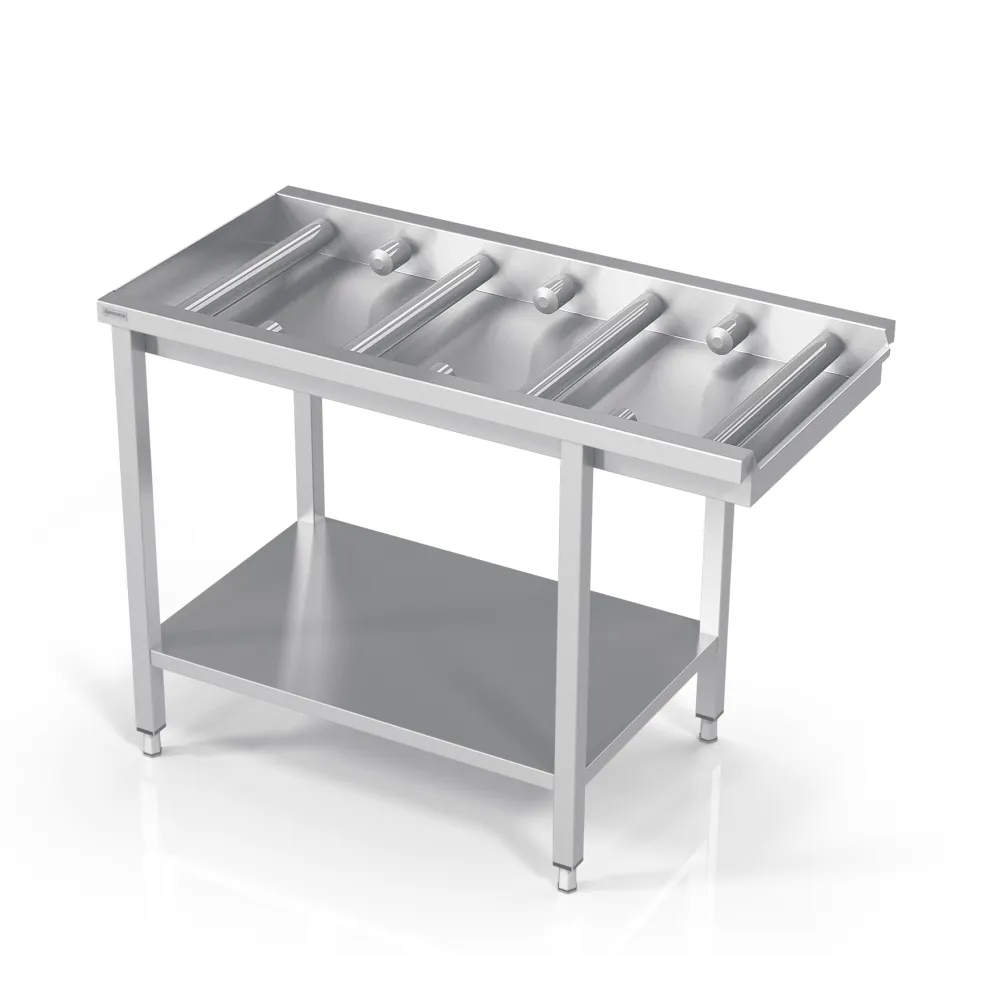
A stainless-steel transfer table organises the flow from soiled dishes to the dishwasher. Two sets of rollers—one long, one short—let staff slide racks of plates, glasses or cutlery across the worktop without lifting. The fixed shelf underneath holds detergent, rinse aids or clean crockery ready for unloading, keeping the workspace clear above.
The principle is simple: gravity and low friction replace manual carrying. The rollers are set at a slight downward pitch so that loaded racks move forward with a gentle push. This reduces strain on staff and speeds the cycle between service and wash. Because the table stands directly beside the dishwasher, dirty items travel the shortest possible distance, cutting spills and breakage.
To use the table, staff load soiled dishes into standard dish racks and place them on the long roller section. A light push sends the rack gliding towards the dishwasher hood. After the wash cycle, clean racks are pulled onto the short roller section for unloading. The shelf below can be stocked with fresh cutlery or stacked plates, ready for the next service.
Construction is all stainless steel for hygiene and durability. The worktop is a single sheet, seamless at the corners, so water and debris cannot collect. The shelf is fixed at a height that allows standard 600 mm dish racks to slide underneath without obstruction.
The overall footprint—2500 mm long, 600 mm deep and 900 mm high—fits the standard gap between a commercial dishwasher and the adjacent worktop or wall. The length gives enough roller space for multiple racks to queue without crowding, while the depth matches the dishwasher hood so racks transfer straight in without sideways movement.
Cleaning is straightforward: wipe the rollers and worktop with a damp cloth and sanitiser after each service. The shelf can be removed for deeper cleaning if needed, though the entry does not specify a mechanism. No moving parts require lubrication, so upkeep is limited to surface hygiene.