More from this brand
Technical data
| Attributes | |
| ARTICLE | 219208 |
| SIZE L/W/H | 195 |
| NOTES | blade hardness 52-54 HRC |
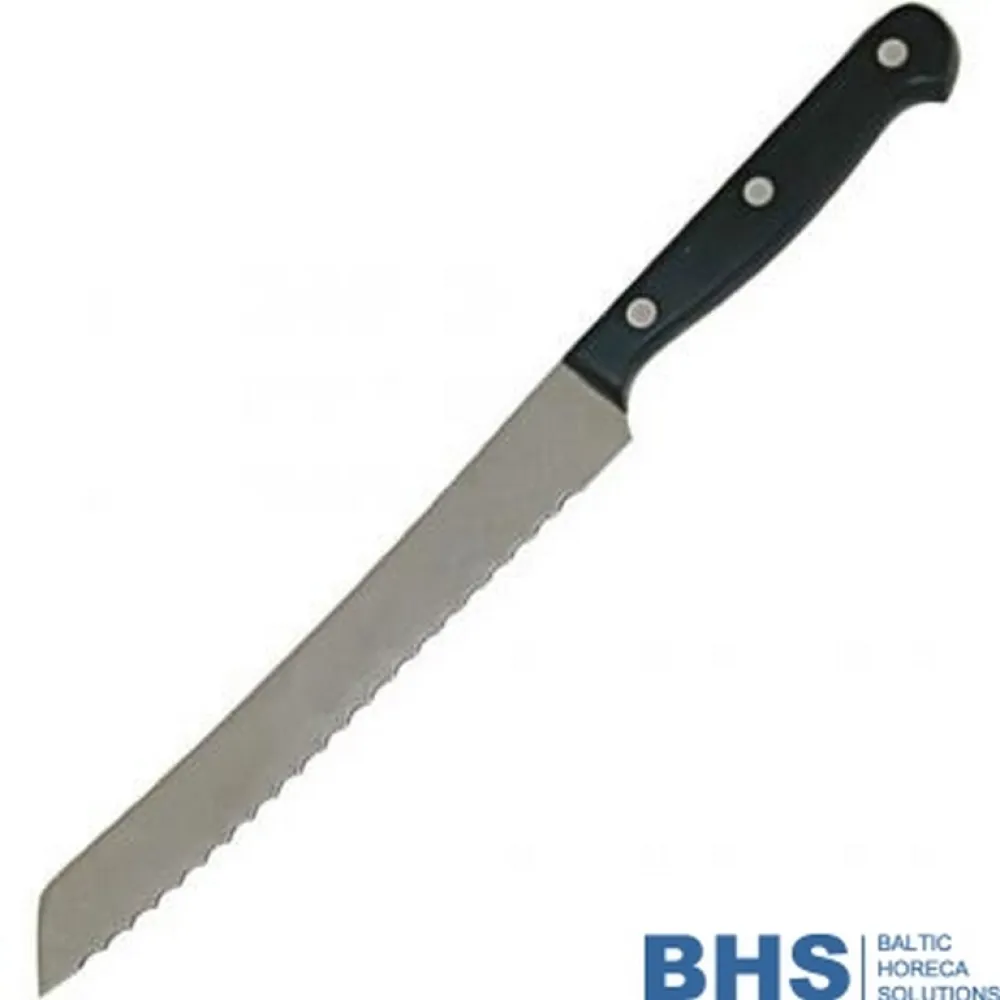
A bread knife cuts through crust and crumb without crushing the loaf. The serrated edge grips the surface, then each tooth acts as a tiny wedge that parts the fibres cleanly. A straight blade would press the crust flat before it broke; the serration keeps the cut shallow and even, so the slice stays intact and the loaf does not tear or compress. The same principle works on delicate pastries and layered cakes: the teeth prevent the blade from dragging or squashing the layers, giving a smooth face that shows the bake clearly.
To use the knife, hold the handle firmly and draw the blade across the loaf in a single, steady stroke. Start at the heel of the blade and finish at the tip, letting the serrations do the work. No downward pressure is needed; the weight of the knife is enough. For large loaves, a gentle sawing motion keeps the cut straight without forcing the blade. The black handle gives a secure grip even when hands are floury or damp.
The blade is hardened to 52-54 HRC, a range that balances sharpness and durability. Below 52 HRC the steel would dull quickly under daily use; above 54 it could become brittle and chip. This hardness keeps the serrations keen through repeated slicing of crusty breads and viennoiserie.
The knife measures 195 mm from tip to heel, a length that suits most commercial loaves and baguettes. A shorter blade would struggle with large sourdoughs; a longer one can be unwieldy on smaller items like brioche or croissants. The single-piece construction has no joints or rivets, so there are no crevices where dough or crumbs can lodge.
Clean the knife by hand in warm water with a mild detergent, then dry immediately. The hardened steel resists corrosion but prolonged moisture can still mark the surface. Store the knife in a knife block or on a magnetic strip to protect the edge from contact with other utensils.