More from this brand
Technical data
| Attributes | |
| ARTICLE | 209160 |
| SIZE L/W/H | 160 |
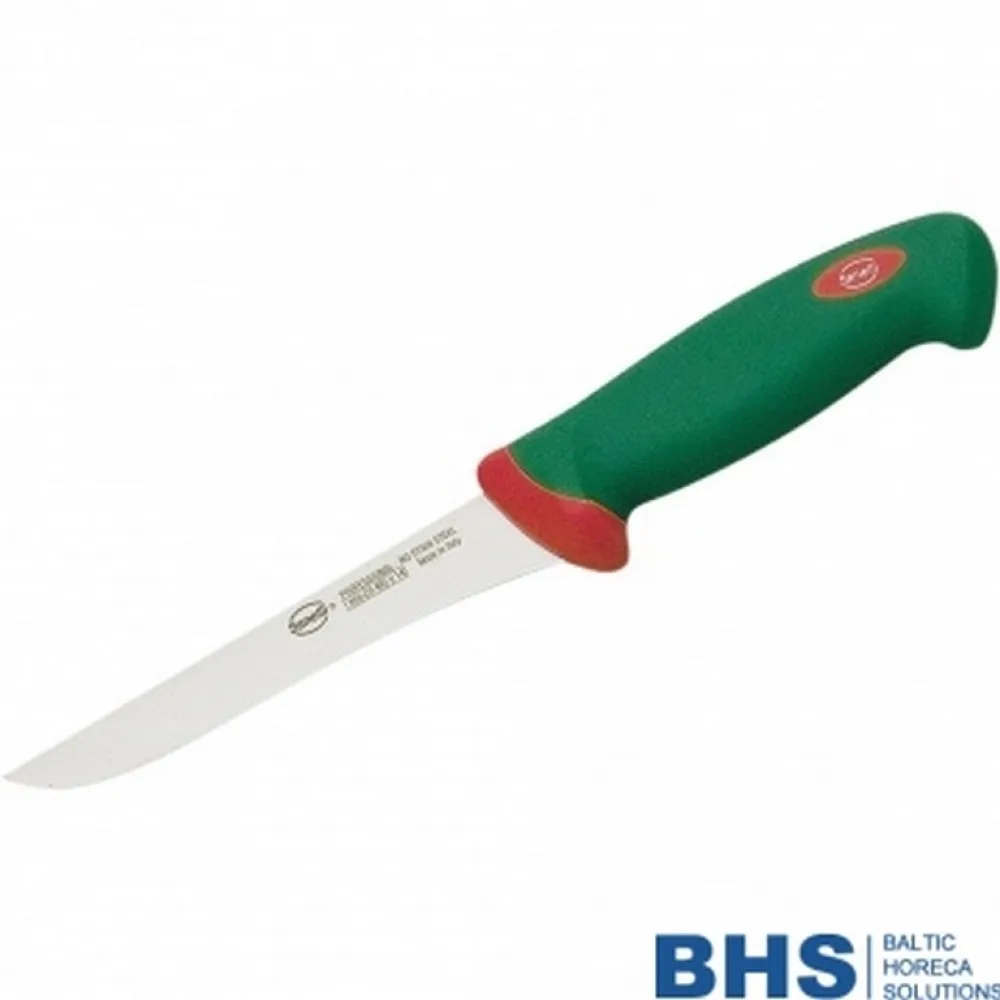
A boning knife separates meat from bone with a narrow, flexible blade that curves into the joint. The thin steel follows the contours of ribs, vertebrae and sockets without tearing the flesh, leaving clean cuts and minimal waste. The flexibility lets the blade bend around the bone rather than forcing the cut, so the operator can work faster and with less effort than a rigid knife would allow.
The 16 cm blade is held at a slight angle to the handle, giving the wrist a natural position when the knife is drawn along the bone. The operator starts at the joint, slides the tip between meat and bone, then draws the blade through the length of the cut. The curved edge keeps the cutting motion smooth and controlled, while the pointed tip reaches into tight spaces such as poultry shoulders or lamb racks.
The blade is hardened to 54-56 HRC, a range that balances sharpness and durability. A softer steel would dull quickly against bone, while a harder one could chip; this hardness holds an edge through repeated use yet can be honed back to sharpness with a standard steel or stone. The steel is Italian-made, a material chosen for its grain structure and corrosion resistance in wet kitchen environments.
The handle combines two plastics: a firm core for strength and a softer outer layer for grip. The shape is oval rather than round, preventing the knife from rolling on the worktop, and the surface is textured to hold even when wet or greasy. The handle is riveted to the tang, which runs the full length of the handle for balance and durability.
The 16 cm length is a mid-size boning knife, long enough to reach into larger joints such as pork shoulders yet short enough for precise work on poultry and small game. The blade's narrow width reduces drag through the meat, so each stroke requires less force and the operator can work longer without fatigue.
Cleaning follows from the materials: the stainless blade resists corrosion but should be washed by hand immediately after use to prevent salt or acid from pitting the surface. The plastic handle can be cleaned in warm soapy water, but prolonged soaking may loosen the rivets over time. The knife should be stored dry, either in a knife block or on a magnetic strip, to protect the edge and prevent the handle from absorbing moisture.
The Sanelli 16 cm boning knife is listed in the Stalgast catalogue under meat preparation tools, alongside filleting and breaking knives for professional catering kitchens.