More from this brand
Technical data
| Attributes | |
| ARTICLE | BBDS18B20 |
| SIZE L/W/H | 70 / 100 / 25 mm |
| CAPACITY | 180 gr |
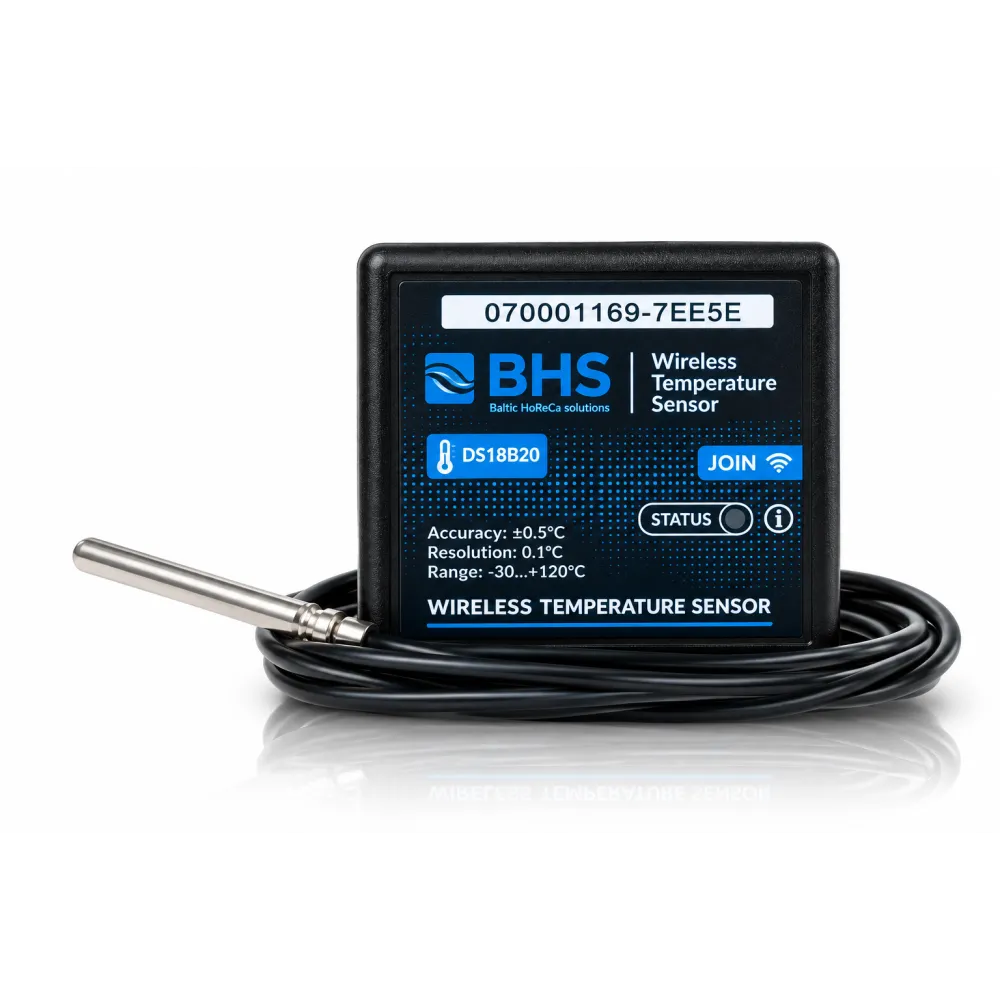
A wireless temperature sensor with a 1 m stainless steel probe for measurements in freezers, cold rooms, air ducts, equipment and liquids.
Probe measuring range -30 °C…+120 °C, accuracy ±0.5 °C, step 0.1 °C. The probe sits in the monitored zone while the sensor body stays outside, easy to service. Replaceable AAA batteries lasting up to 5 years, 868 MHz communication with AES-128 encryption.
- : BHS-HoReCa
- Article number: BBDS18B20
BHS Wireless Temperature Sensor with Probe BBDS18B20
A wireless sensor with an external digital probe for remote temperature monitoring where the measurement must be taken at a specific point while the device itself stays outside the monitored zone. Suitable for freezers, cold rooms, ventilation ducts, process equipment, tanks and liquids.
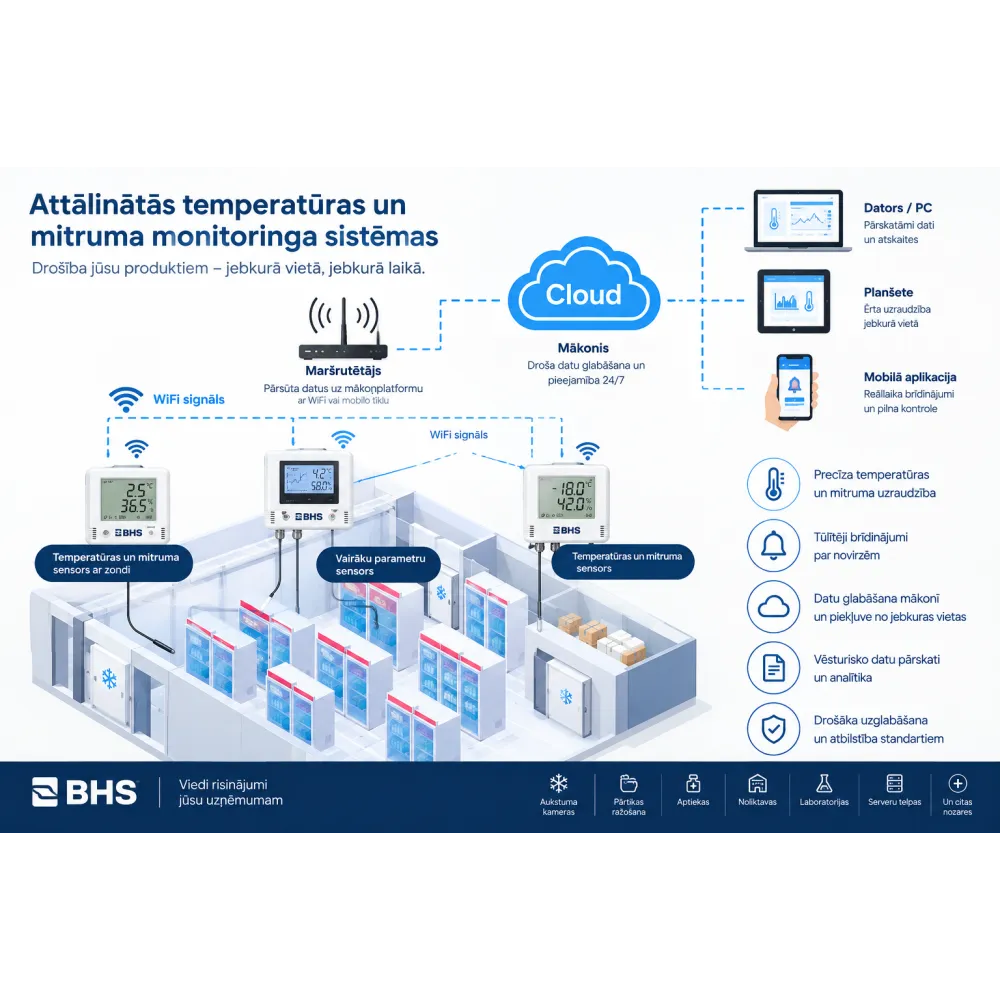
The probe measures temperature from -30 °C to +120 °C with ±0.5 °C accuracy and a 0.1 °C step. Every 5 minutes a reading is transmitted over an AES-128 encrypted 868 MHz radio channel to a gateway, which forwards the data to the cloud monitoring platform. There you can review measurement history and charts, set limit values, receive alerts and generate reports.
Unlike sensors with a built-in element, this model lets you pass only the thin probe through a door seal or cable entry, while the body with the batteries stays outside — this improves radio communication and makes battery replacement easier.
Key benefits
- Wide probe measuring range -30 °C…+120 °C
- ±0.5 °C accuracy across the full range, 0.1 °C step
- 1 m SUS304 stainless steel probe; longer options available on request
- The sensor body stays outside the cold or hot zone
- Replaceable 2 × AAA batteries with up to 5 years of service life
- 868 MHz wireless communication, range up to 150 m in clear line-of-sight conditions
- AES-128 data encryption between sensor and gateway
- Diagnostic button and status LED for checking the connection
Applications
- Commercial refrigeration — display cabinets, refrigerators, freezer cabinets and cold rooms
- Cold storage and food storage zones
- Pharmacies and medicine storage — refrigerators and cabinets
- HVAC and ventilation — air duct temperature monitoring
- Production equipment, pipelines and process environments
- Tanks and liquids — water, beverages, chemical and process fluids
- Server rooms and data centres
- Museums and archives
Installation
The sensor body is mounted with industrial double-sided adhesive tape on a smooth surface — plastic, metal, glass or a painted wall. No drilling or additional hardware is required. Once the body is mounted, the probe is placed where the temperature has to be measured.
Important: the probe is designed for a wide range, but the sensor body operating temperature is -20 °C…+55 °C, so the body must be positioned within these limits and inside the wireless gateway's coverage area. The device is shipped switched off; operation starts by pressing the join button and registering the sensor in the cloud portal.
Technical details
| Article number | BBDS18B20 |
| Sensor element | DS18B20 digital sensor in an external probe |
| Measuring range (probe) | -30 °C … +120 °C |
| Sensor body operating temperature | -20 °C … +55 °C |
| Accuracy | ±0.5 °C across the full range |
| Resolution / step | 0.1 °C |
| Measurement interval | 5 minutes |
| Probe material | SUS304 stainless steel |
| Probe cable length | 1 m; longer options on request |
| Radio frequency | 868 MHz ISM band |
| Transmission power | +14 dBm, 25 mW |
| Communication range | up to 150 m line-of-sight |
| Data encryption | AES-128 |
| Power supply | 2 × AAA 1.5 V replaceable batteries; lithium recommended for sub-zero temperatures |
| Battery life | up to 5 years at the default interval |
| Protection rating | IP54 (sensor body) |
| Dimensions | 67 × 67 × 25 mm (sensor body) |
| Mounting | industrial double-sided adhesive tape for smooth surfaces |
| Compliance | CE, RoHS |
A compatible wireless gateway is required for operation. BHS specialists carry out system installation, probe placement, programming, limit and alarm configuration, and staff training.